
THE HANGOVER REPORT – Led by Dudamel, NY PHILHARMONIC kicks off its opera series at Carnegie Hall with a vivid, detailed account of Puccini’s “Tosca”
- By drediman
- November 16, 2026
- No Comments
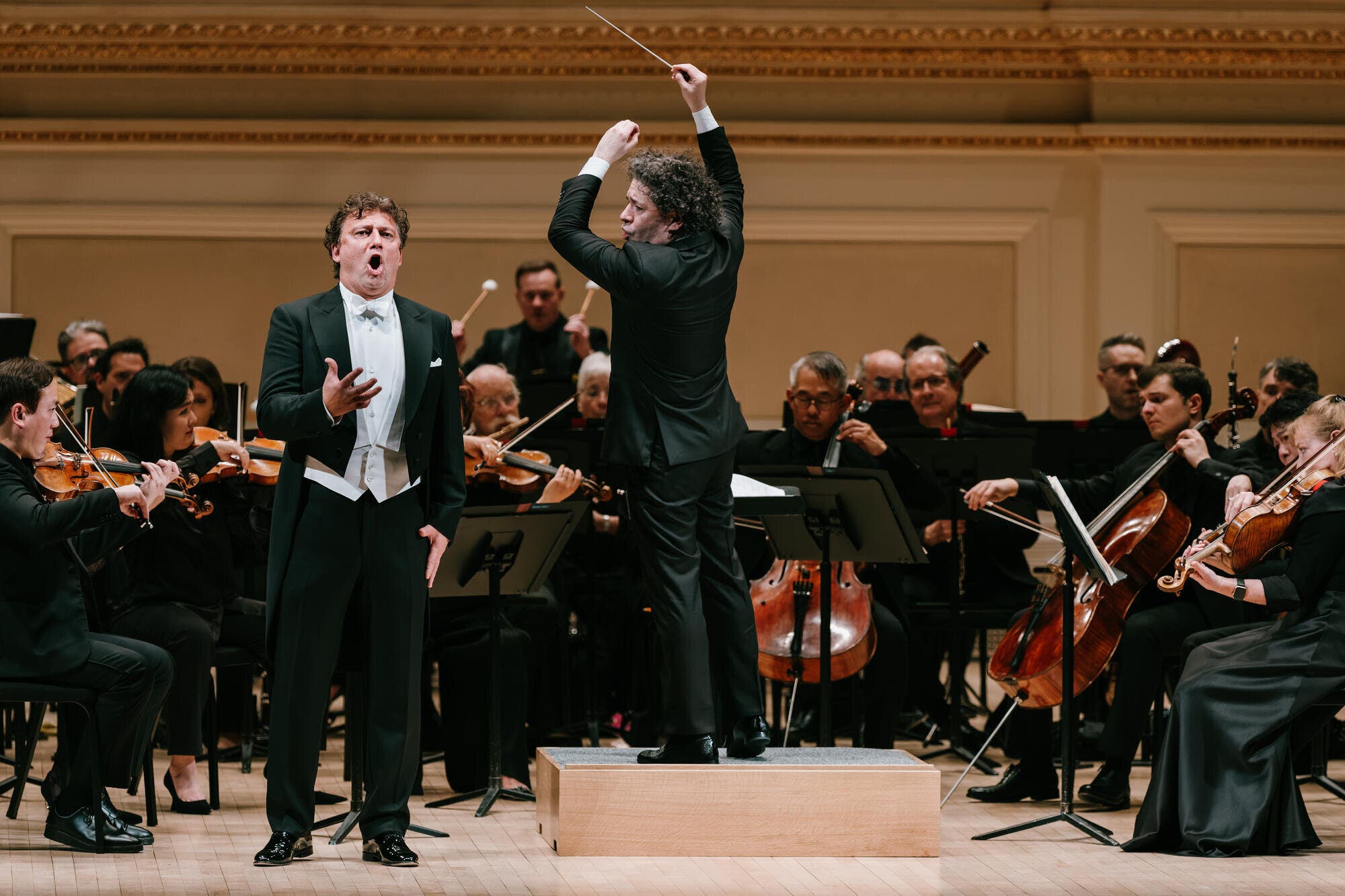
This past weekend in New York, it was possible to have seen two high profile performances of Puccini’s evergreen Tosca. While I myself was at the sold out Sunday matinee of the New York Philharmonic’s highly anticipated concert rendition of the fan favorite opera at Carnegie Hall (the performance also took place on Friday night), it was also being performed at the Metropolitan Opera in Sir David McVicar’s traditional, fully staged production. The Philharmonic’s performances marked the commencement of a five-year collaboration between the orchestra and Carnegie Hall to present concert versions of operas in their entirety, ambitiously putting the Philharmonic in direct competition with the mighty Met. Conducted by the ensemble’s red hot maestro Gustavo Dudamel, the performance also boasted some deluxe casting, including beloved tenor Jonas Kaufman as the painter-cum-revolutionary Cavaradossi, soprano Marina Rebeka in the tempestuous title role, and baritone Ludovic Tézier as the villainous and lustful police chief Scarpia.
Because much of the storytelling is told through Pucchini’s seamless symphonic scoring, there’s arguably little need for actual physical sets for a satisfying performance of the opera, especially when you have orchestral playing as vivid and meticulously rendered, singing as passionate yet finely tuned, and acting as compellingly wrought as they were this weekend. By putting the music-making front and center, one could more easily take in and bask in the textures of the orchestral writing, especially when performed in a hall with acoustics as impeccable as the Stern Auditorium / Perelman Stage’s. Throughout, the Philharmonic’s music director struck just the right balance between creating forward momentum and drawing out the many details entrenched in the score that otherwise might be missed when watching a production in an opera house with the players in the pit, from which the musical performance can occasionally be sonically muddled. Suffice to say, by all accounts, Dudamel and the New York forces on this occasion delivered a luxurious account of Puccini’s score.
Then there was the cast, which came up with equally luxurious performances. As the titular Tosca, Rebeka gave a fully realized dramatic and vocal turn that both got the blood pumping and melted the heart. Indeed, it’s hard to believe that her appearance this past weekend was her debut in the coveted role. Over the course of the evening, her steely yet pliantly expressive singing rang with conviction, character, and clarity. To boot, the Latvian soprano looked glamorous, striding onto the stage in a trio of different gowns — white, red, and black — one for each of the opera’s three acts. As her lover Cavaradossi, Kaufman — a bona fide international operatic icon, if there ever was one — gave a well-measured performance that was anchored by his weighty, darkly hued tenor, even if the German star’s singing has lost some of its effortless luster. Last but not least was Tézier, whose Scarpia was animated by the French baritone’s insidious acting and incisive vocal choices in an altogether chilling performance.
HIGHLY RECOMMENDED
TOSCA
Opera / Classical Music
New York Philharmonic at Carnegie Hall
2 hours, 30 minutes (with one intermission and a brief pause)
Closed
 Copyright © 2026
Leave a Reply