
VIEWPOINTS – The magisterial KING AND COUNTRY cycle at BAM showcases the RSC in tip-top form
- By drediman
- April 14, 2016
- No Comments
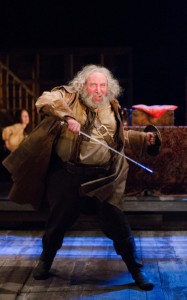 After last season’s epic Wolf Hall on Broadway, the venerated Royal Shakespeare Company returns to New York to present some more juicy tales of the triumphs and woes of English royalty with its current Henriad productions, which includes Shakespeare’s Richard II, Henry IV Part I, Henry IV Part II, and Henry V. These majestic and multifarious history plays are currently being gift-wrapped by the RSC under the umbrella title King and Country: Shakespeare’s Great Cycle of Kings at BAM’s Harvey Theater. I encourage you not to miss it. Gregory Doran’s magisterially-acted, largely and refreshingly gimmick-free productions – which manage to both highlight the individuality of these great plays while magnificently maintain a sense of unified continuity in what is essentially a single panoramic narrative – surely not only represent one of the centerpieces of this anniversary year (2016 marks the 400th year since the Bard’s death), but also one of the truly memorable highlights of this theatergoing season. Unlike last year’s DruidShakespeare (which condensed the Henriad into a single 6-hour production) or Henry IV at St. Ann’s Warehouse (the Donmar Warehouse co-production combined both parts into a single intermission-less production), the RSC’s King and Country productions present Shakespeare’s plays individually per evening in essentially their respective entireties. The cumulative impact of this comprehensive, undiluted, yet carefully considered approach, especially as executed here and seen in quick succession, is considerable.
Appreciating the collective breadth of Shakespeare’s achievement
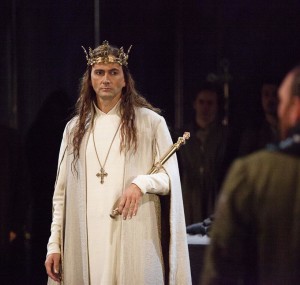 One of the great pleasures of seeing the complete Henriad in back-to-back productions with a single cast is the ability to follow each of the characters’ arcs, in all their nuanced shadings, unhurriedly across the four plays (the average run time of each production is three hours). Seen in one-off productions, many of these characters can come across as stiff and two-dimensional. But seeing Bolingbroke blossom from an upstart rebel to the King of England to a dying old man – all the while keeping his trademark paranoia – truly unlocks the character. Similarly, having recent memories of Richard II and Henry IV’s tumultuous reigns (“Uneasy lies the head that wears a crown”) contributes much-needed depth and suspense to the otherwise straightforward, valedictory Henry V. Even Falstaff’s gradual demise across the three Henry plays adds a tint of vulnerability to the iconic implacability of this much loved character. It’s also a treat to see Falstaff’s jovial yet frustrating Eastcheap companions make frequent appearances in these works – they become less comic relief and more of an essential thread of the fabric of the story Shakespeare is telling.
As a result, not only do the characters become more complex and fascinating, each of the plays themselves takes on a richer hue that would have been otherwise missed if they were seen individually. Here are a couple of examples. Henry IV becomes more central in the plays that bear his name because we’ve just seen him win the crown in Richard II. The once frustratingly redundant Henry IV Part II is more poignant – becoming a moving farewell to Henry IV and Falstaff (although his death is described vividly in Henry V). The famous St. Crispin’s Day speech in Henry V is now a more personal and touching breakthrough moment coming from the same mouth that indulged in sack with Falstaff in Eastcheap.
Finally, although these plays tell a single multi-generational tale, Shakespeare’s astonishing achievement in these works is his use of different modes of storytelling in each play – from the delicate poetry of Richard II, to the panoramic view of humanity in Henry IV Part I, to the autumnal glow of Henry IV Part II, and ultimately to the chorus-driven bombast of Henry V. Seeing the plays together allows one to appreciate the variety and richness of Shakespeare’s storytelling arsenal.
Flexing the company’s deep well of acting resources
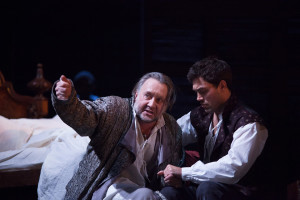 In terms of acting, I don’t think I’ve seen the RSC players, whom I’ve caught numerous times domestically and abroad over the last two decades, better than they are here. The RSC aesthetic seems to be most compelling when asked to flex its muscles to bring to life lengthy and complicated stories (note that two of the company’s greatest successes have been their stage adaptations of two lengthy and complicated novels, Charles Dickens’ The Life and Adventures of Nicholas Nickleby and Victor Hugo’s Les Misérables), with much of the company asked to play multiple roles. In other words, the RSC players are some of the best-drilled ensemble actors around and the chance to see them churn out a story as big as the one told in the Henriad is to see them at their best.
Sure, much of the attention has been grabbed by the flashy star turns – and rightfully so – of Anthony Sher’s boisterous, deliriously ripe Falstaff and David Tennant’s flamboyant, unsettlingly brittle Richard II, but they’re only two cogs in a much larger machine. Mr. Sher and Mr. Tennant’s eye-catching histrionics are wonderfully complimented by the the fiery muscularity and sturdiness of Jasper Britton and Alex Hassell’s Bolingbroke/Henry IV and Hal/Henry IV, respectively. It’s a testament to these four actors’ considerable skill and dedication that their performances – so beautifully clear and un-rushed (thank you, also, Mr. Doran) – remain as fresh and thrillingly vibrant as they are (they’ve been doing this for a while now; this Richard II premiered nearly three years ago across the pond).
But back to the extraordinarily versatile and resourseful ensemble, the true star of this cycle, especially when the productions are seen together. Over the past week, I encountered a number of portrayals that were absolute treasures, particularly from two indispensable and hard-working veteran actors, Oliver Ford Davies (who plays the Duke of York, Justice Shallow, and Chorus in Henry V) and Joshua Richards (who plays Earl of Worcester, Bardolph, and Fluellen). Their impeccable delivery, ability to completely lose themselves in their characters, and be thoroughly in the moment should be seen by every aspiring actor. I also can’t not mention the excellent work by some of the younger company members, particularly Matthew Needham (a truly fiery Hotspur; also Shadow) and Sam Marks (so moving as the Duke of Aumerle; also Ned Poins and the Constable of France). Luckily, in the midst of these testosterone-driven plays – King Richard II aside – Shakespeare also gives us strong women, whose steely resolve are given full justice by the superb Sarah Parks (Duchess of York, Mistress Quickly) and Jennifer Kirby (Lady Percy, Katherine).
A technical challenge and triumph
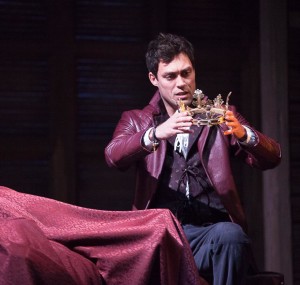 As you can imagine, mounting all the Henriad plays simultaneously presents a number of technical challenges. All of these are met triumphantly by the RSC’s design team, at least from what I saw at BAM. Despite utilizing an imposing tiered unit set by Stephen Brimson Lewis – which blends beautifully into and takes full advantage of the Harvey’s tastefully decrepit structure – each of the plays marvelously takes on a strikingly different look and sound (the gorgeous-sounding live music is by Paul Englishby). As with mostly all of the RSC’s productions, the lighting and costuming are exceptional. Lighting designer Tim Mitchell swathes the stage with gorgeous and atmospheric Rembrandt-like lighting. The costumes, supervised by Stephanie Arditti, are detailed and seemingly period perfect.
HIGHLY RECOMMENDED
KING AND COUNTRY: SHAKESPEARE’S GREAT CYCLE OF KINGS (RICHARD II, HENRY IV PART I, HENRY IV PART II, HENRY V)
Off-Broadway, Play
Royal Shakespeare Company at BAM
Each play is approximately 3 hours (with one intermission)
The cycle runs in repertory through May 1
 Copyright © 2026
Leave a Reply