
VIEWPOINTS – Burning down the house: Wallace Shawn harshly lifts the veil in THE FEVER, James Scruggs uncomfortably interrogates in OFF THE RECORD
- By drediman
- April 20, 2026
- No Comments
This past week, I encountered a pair of caustic Off-Broadway productions that strove to reveal the vast inequities on which our society is built on, namely as it relates our capitalist and justice systems. As per usual, read on for my thoughts on these truth-saying nights at the theater, both of which seriously entertain the notion of burning down the house.
THE FEVER
Greenwich House Theater
Through May 24
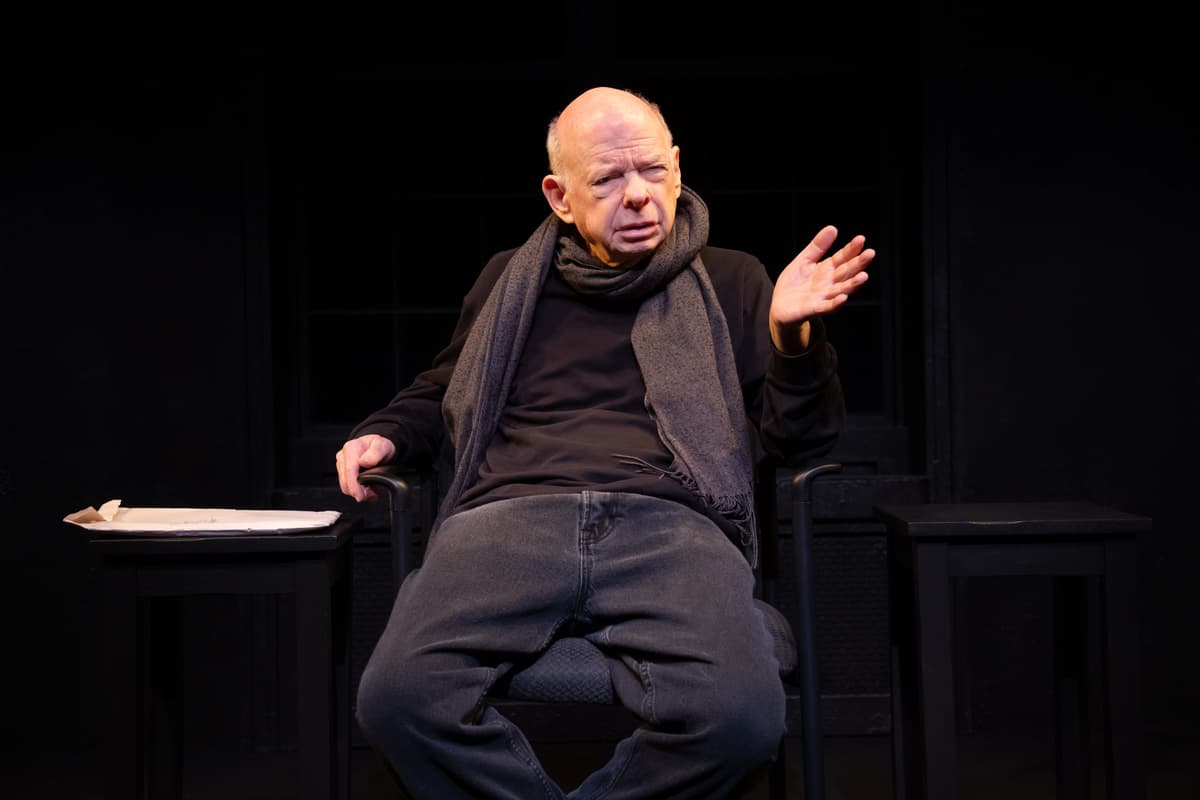
This spring, iconic provocateur Wallace Shawn has returned to his scathing, eye-opening theatrical monologue The Fever (HIGHLY RECOMMENDED), a solo show that has become over the years a reliable vehicle and one of his signature pieces. This time around, it plays in repertoire with his latest play What We Did Before Our Moth Days during its dark nights (Sundays and Mondays). In The Fever, a nameless narrator — played by Shawn — finds himself relegated to a hotel room located in an undisclosed foreign country, where he is overwhelmed by fever-induced hallucinations. As a political execution takes place just outside the window, his wandering mind grapples with his own sense of entitlement, namely his complicity with the capitalist system that has repressed — and in some cases, exterminated — the poor. Intense and disconcerting, Shawn’s haunting, intellectually-bent fever dream plainly holds a mirror to the audience, harshly lifting the veil to reveal a stark and grim portrait of society and its merciless capacity for human suffering and incapacity for true empathy towards “the other” and the have-nots, particularly when privilege and personal gain are involved. Indeed, the work is relentless, a ruthlessly damning and accusatory critique that makes for chilly viewing, especially unsettling when coming from Shawn’s unassumingly jovial persona. The narrator’s goal here seems to be to guilt himself and the audience into political awareness. At the same time, however, he openly admits to our inability to inherently alter our behavior, suggesting in between the lines that a complete reset is the only real option for change. Ever the master storyteller, Shawn navigates the play’s labyrinthine passages with unsurprising familiarity, at times ad libbing with the audience, as needed, to warm them up before stealthily ensnaring them.

OFF THE RECORD: ACTS OF RESTORATIVE JUSTICE
HERE
Closed
Then it was HERE’s production of Off the Record: Acts of Restorative Justice (RECOMMENDED), James Scruggs’ immersive and interactive diatribe against the U.S. criminal justice system. Although not nearly as elaborate as his menacingly carnivalesque production of 3/Fifths nine years ago (which I had the privilege of experiencing), Scruggs’ latest is no less confrontational as it investigates what it means to be person of color in this country as it relates to justice and civil rights. Co-written by lawyer and criminal justice advocate Thomas Giovanni, the production unfolds as a series of increasingly pointed questions posed to the audience — some more directly than others — regarding whether our country’s criminal justice system is irrevocably broken, and if so, whether the only alternative is to burn it all down and start anew from the ashes of its demise. Part lecture, part interactive game, the audience plays a key role in how it all shakes out, although I have a strong suspicion that each performance arrives at the same pessimistic and downbeat conclusion, especially when supported throughout the evening by examples of blatant inequities and overwhelming statistical evidence. As Michael Rohd and Annalisa Dias’s provocative, experiential production unfolds through an array of stylistically divergent sub-presentations led/moderated by members of the company — augmented by some encompassing lighting and video design work — there are definite shades of the biting satire of plays like George C. Wolf’s The Colored Museum, as well as the ritualistic community-building of Alesha Harris’s What to Send Up When It Goes Down. If it all doesn’t quite amount to the guttural sucker punch its creators intended, I nevertheless applaud the endeavor’s attempt to uncompromisingly interrogate — no matter how uncomfortably — a faulty system.
 Copyright © 2026
Leave a Reply