
VIEWPOINTS – Work that (literally) kills in a dystopian world: Assessing the Off-Broadway revivals of THE ADDING MACHINE and THE RECEPTIONIST
- By drediman
- May 14, 2026
- No Comments
Currently on the boards this spring theater season, you’ll find a pair of Off-Broadway revivals depicting the fraught psychological minefield of employment in a dystopian, not so unfamiliar corporate world. As per usual, read on for my thoughts on these fascinating companion pieces.

THE RECEPTIONIST
Second Stage Theater at Pershing Square Signature Center
Through May 24
First up this past weekend, I had the opportunity to catch the fabulous two-time Tony-winner Katie Finneran in the title role of Second Stage Theater’s revival of Adam Bock’s 2006 play The Receptionist (SOMEWHAT RECOMMENDED). Taking inspiration from such plays such as Elmer L. Rice’s The Adding Machine — which I’ll be discussing below — the dark comedy is in essence a commentary on soul-crushing bureaucracy and the sinister motivations that drive capitalist and corporate machines. At the center of Bock’s intentionally vague cautionary tale is Beverly, the receptionist at the bland Northeast Office of a large, nameless company that’s hinted to be involved in dubious activities. In this lovingly-wrought character, Bock juxtaposes the menacing intentions of the corporation for which she blindly yet diligently works and the defiant and determined humanity with which she conducts every duty and office interaction. Invariably, Beverly takes comfort in the small pleasures that life can offer (e.g., indulging in pastries, building her cherished teacup collection). Simmering just underneath the surface of her forcefully bubbly and upbeat personalty, however, is a desperation to keep her composure at all cost, particularly in her role as the office’s sole reliable pillar of support — at times in a more professional capacity than others. Thankfully, Finneran is up to the task, delivering a multi-layered performance of great specificity that finds quirky humor in the unlikeliest of circumstances. Unfortunately, most everything else in the play seems destined to remain simply loose ends, which undermines the sense of menace the playwright was clearly striving for. Despite some fine performances from the rest of the cast, the otherwise talented director Sarah Benson fails to successfully shape the somewhat lopsided trajectory of Bock’s play. That being said, working in her favor is the nostalgic office set by the design collective dots, which is abound in retro Easter egg details.
THE ADDING MACHINE
The New Group at the Theatre at St. Clement’s
Through May 17
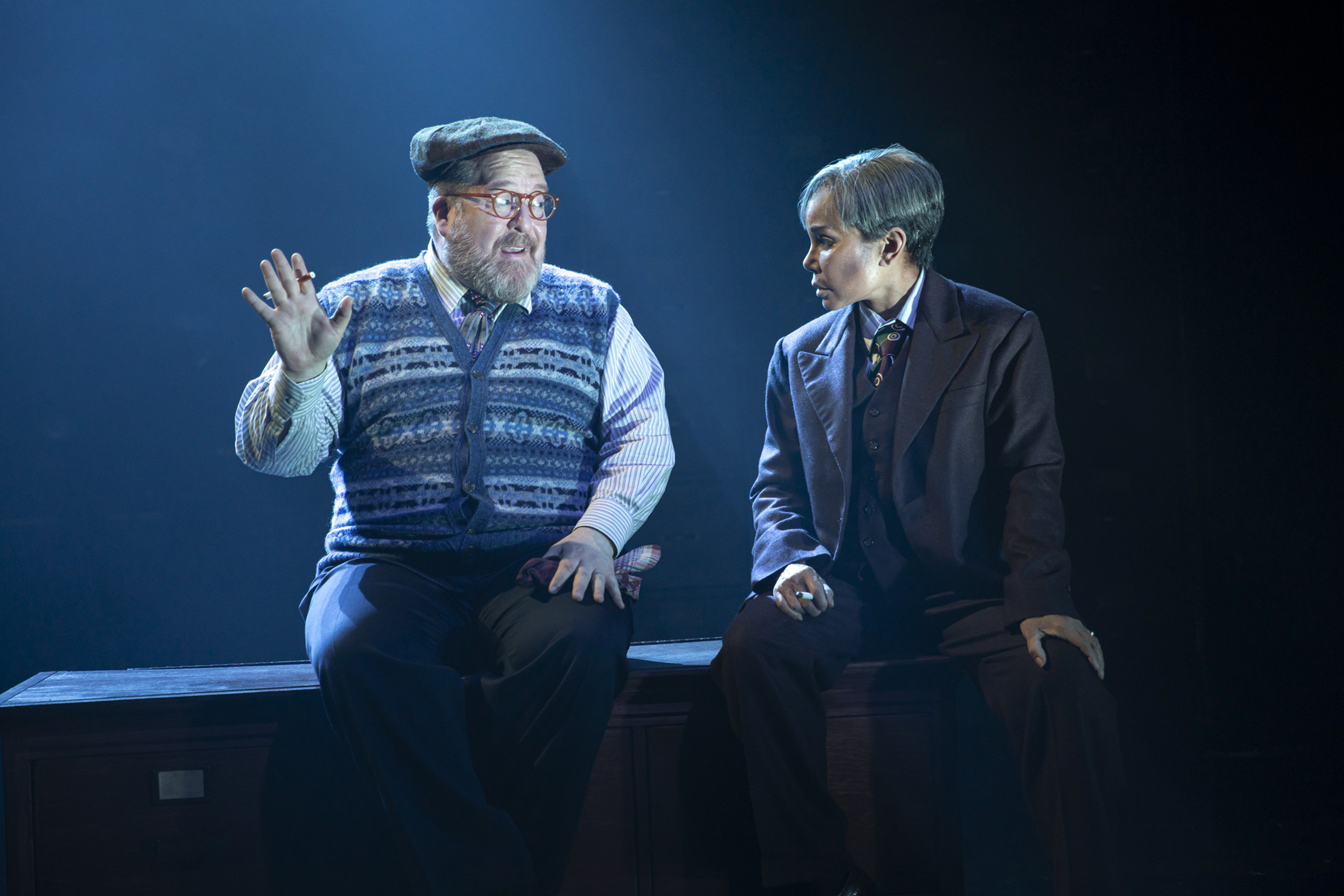
Also on the boards this spring is Scott Elliott’s Off-Broadway revival of Elmer L. Rice’s classic expressionistic play The Adding Machine (SOMEWHAT RECOMMENDED) for The New Group at the company’s new home at the Theatre at St. Clement’s in Hell’s Kitchen. Featuring new hand-holding revisions by Thomas Bradshaw, the play tells the story of Mr. Zero, whose unchanging daily routine is disrupted when he is inhumanely made redundant in his dull corporate accounting job of 25 years, only to be replaced by the titular “adding machine”. To retaliate, he resorts to succumb to his base human instincts, which leads to a bloody chain of events that continues into the afterlife (no spoilers here). Suffice to say, Rice’s play remains relevant as a reflection on the impacts of current-day automation and the overall increasing inhumanity of existing in contemporary society. Despite the play’s timeliness, there are admittedly issues with the play itself. Notably, there are stretches of dialogue that ramble without much filter — particularly Mr. Zero’s self-indulgent monologues — which a cross-dressing Daphne Ruben-Vega nevertheless expertly handles with patience and game determination. Part of the culprit is Elliott’s strangely cautious pacing, which could benefit from faster tempos to really highlight the play’s sense of urgency and fever dream quality. Fitting most seamlessly into Rice’s distorted world is Jennifer Tilly, who is giving a heightened, larger-than-life performance as the frustrated and frustrating Mrs. Zero. Despite my reservations, the visual production is never less than evocatively designed. Special mention must go to Derek McLane’s antique-focused set design and Jeff Croiter’s noir-ish lighting, which are beautifully in line with the moody expressionism of the piece. Rounding out the cast are Michael Cyril Creighton as the play’s narrator (and various other actors) and Sarita Choudhury as Mr. Zero’s weary work colleague Daisy — both of whom give it the old college try without the sufficient guidance for success.
 Copyright © 2026
Leave a Reply