
VIEWPOINTS – Intimate, haunting two-handers I just can’t stop thinking about: Billy McEntee’s SLANTED FLOORS and Dan Giles’ THE CHARIOTEER
- By drediman
- November 12, 2026
- No Comments
This past weekend, I had close encounters with a pair of haunting Off-Broadway two-handers that caught me off guard with the candid way they explored domesticity and the crevices of intimate human relationships (one a romantic partnership, the other a siblingship). As always, read on for my further thoughts.
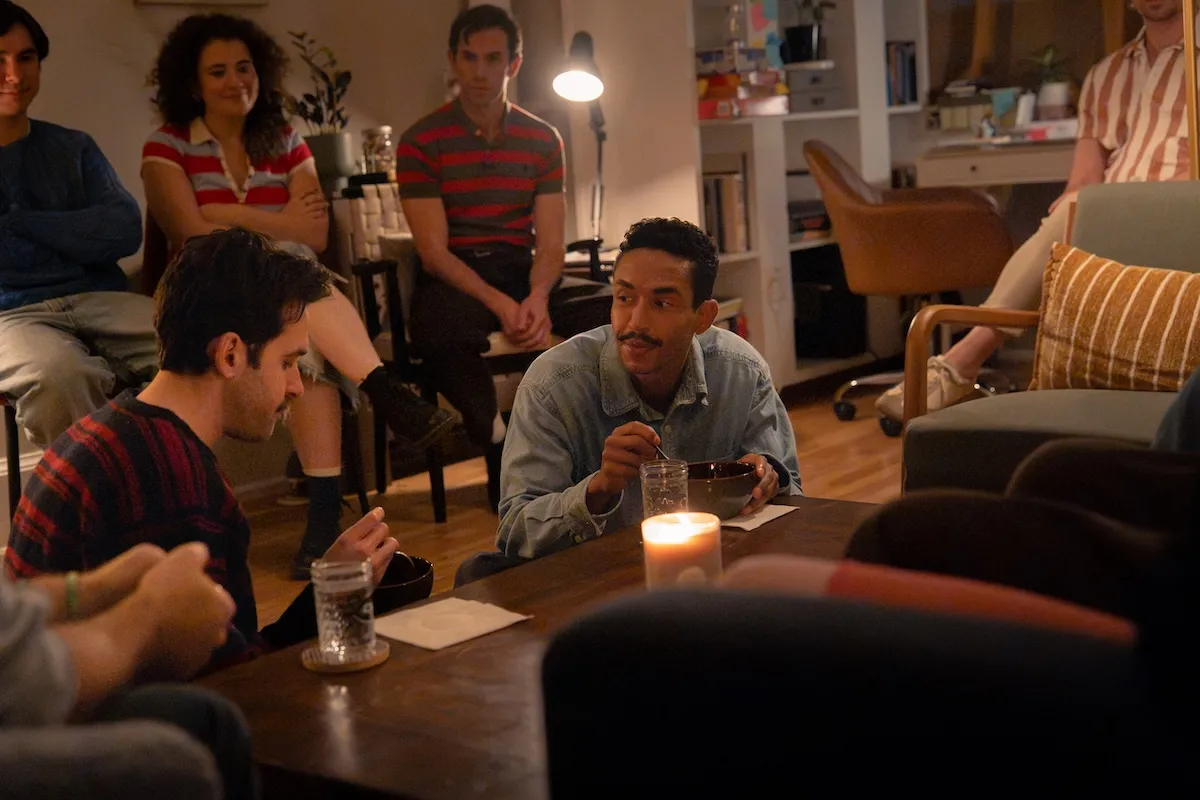
SLANTED FLOORS
Astor Place Theatre
Through November 29
Currently running literally in an apartment next door to the Astor Place Theatre on Lafayette Street is Slanted Floors (HIGHLY RECOMMENDED). After having been mounted twice in even more cramped quarters in a Greenpoint apartment in Brooklyn, the play’s third production in downtown Manhattan has expanded its audience from a mere six to now a whopping thirty. The work depicts a night in the lives of Kaplan and Teddy, a youngish gay couple who live in a cozy rent stabilized apartment in New York. Both hustling to pursue their dreams in the big city — namely to create theater — many would argue that they’re living the dream. But are they really? As amusingly illustrated by the show’s prelude — a mix of of mime and an onslaught of amusingly telling video captions — the daily grind is real, at least from the perspective of Kaplan (Adam Chanler-Berat), a content creator who freelances from the apartment. When his boyfriend Teddy (Kyle Beltran) returns home from work, he’s also noticeably weary and even a tad disoriented, although his calmer demeanor goes a long way in camouflaging his mood. Their night proceeds with a home-cooked meal, which a small handful of premium ticket-buyers get to partake in, as well. As things unfold, you’ll likely pick up small instances of tension in their exchanges. Indeed, it slowly becomes clear that they don’t quite see eye-to-eye on a number of things, despite the small adjustments both make — respectfully, patiently — to recalibrate the conversation. Over dinner, Teddy confidingly shares with Kaplan (and by extension, us the audience) a quietly ravishing story that he’s been working on, a speculative tale about small groups of people retreating from the grasp of society to reclaim clarity and agency in their own lives. You see, Teddy seems to carry another fully realized world within, one in which performance, escapism, and reality merge. The subtle magic of McEntee’s play and director Ryan Dobrin’s staging is their ability to embrace intense naturalism while simultaneously puncturing it, creating a liminal space where multiple realms can co-exist, including one in which we’re spectators — literally flies in the wall — and another one in which we are metaphysical participants in the proceedings. Although both characters are crucial, the true heart of the show is Teddy, who is portrayed with disarming grace and quiet urgency by Beltran, who is also quite the exquisite storyteller. Obsessed with lists and the logistics of daily life, and therefore prone to preoccupation, Kaplan proves to be the antithesis of Teddy, and is played with convincing authenticity by Chanler-Berat .
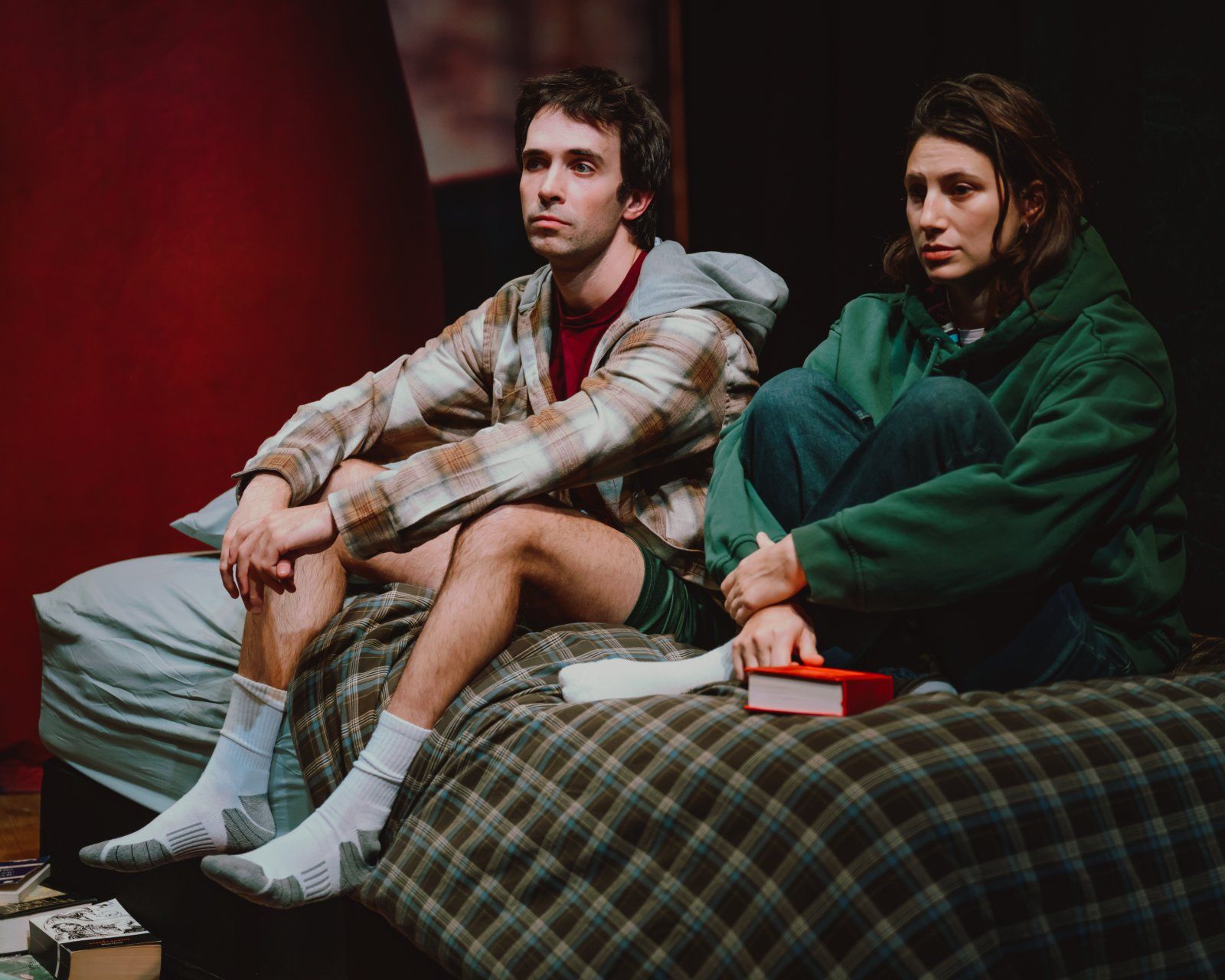
THE CHARIOTEER
the cell theatre
Through November 22
Then over at the cell theatre in Chelsea, I found myself also beguiled by the new two-hander The Charioteer (HIGHLY RECOMMENDED) by Dan Giles, a playwright whose work I previously wasn’t familiar with. Presented as a sort of memory play told from the perspective of a woman named Charly, the work tracks her evolving relationship with her older brother Owen over the course of a decade. Unfolding with impressive economy and specificity afforded by only a few bold strokes, the 75-minute play is essentially comprised of two scenes between the siblings — the first one in which a high school-aged Charly (Mia Wurgaft) visits Owen (Jake Horowitz) in his unkempt dorm room at the University of Massachusetts at Amherst, and the second taking place ten years later at Charly’s Crown Heights apartment in Brooklyn, where Owen shows up unexpectedly after years of not being in contact with this family. These are bookended by short rhetorical monologues delivered by Charly, during which she directly addresses her mother, thereby establishing their tense, labored relationship (Owen has all but disowned his family besides his infrequent catch-ups with Charly). Despite their opposite demeanors (she’s calm and collected, while he’s more apt to emotionally and brashly react to things) and diverging political views (she’s able to function within the rules of society, while his extremist stance tends towards revolution and burning down the system), they nonetheless have a strong, even symbiotic bond with each other. The result is a tug-of-war rapport that reveals their intense devotion to each other, which ironically goes so far as to cause physical harm to each other. When push comes to shove, Charly is as tough as nails, somehow maintaining a relationship with their doting, insufferable-seeming mother, and even brushing off a possible instance of sexual abuse at the hands of a college student on that fateful night at UMass Amherst. On the contrary, Owen is constantly in flight and deflect mode. Unsustainably operating in a state crisis, he’s by far the more vulnerable and volatile of the two. As with Kyle Beltran and Adam Chanler-Berat in Slanted Floors, Horowitz and Wurgaft have crafted captivating performances. Wurgaft delivers a simmering, impeccably wrought performance, giving full weight to the complexity of a woman whose steadfast need to control unhealthy relationships drives herself to a place of mental instability. Horowitz does well to convey the juvenile and impulsive behavior of a man who has had to only think through things part way. Director Matt Dickson‘s resourceful yet evocative staging largely stays out of the way of the two actors’ way, capturing them eloquently in their characters’ psychologically fragile states. For the production, the cell’s bespoke townhouse interior space has been ingeniously and tastefully retrofitted for the play’s world by scenic designer Cat Raynor.
 Copyright © 2026
Leave a Reply