
VIEWPOINTS: Using Traditional Ballet Vocabulary to Inform Fresh Visions
- By drediman
- May 5, 2014
- No Comments
Over the weekend, the New York City Ballet concluded its exploration of 21st century choreographers, which included the likes of Peter Martins, Alexei Ratmansky, William Forsythe, Angelin Preljocaj, Christopher Wheeldon, and City Ballet’s own Justin Peck. Among the ten or so 21st century works presented in this mini-festival, three stood out from the crowd as ballets that skillfully fused the traditional ballet toolkit with contemporary sensibilities. Unlike a number of pieces that make up the core of the classical ballet repertoire (for example, “Swan Lake”, “The Nutcracker”, “La Bayadere”, to name a few), which feature choreography that (albeit beautiful) are interchangeable with each other, these three 21st century works have created vibrantly independent visions of what contemporary ballet can be by using essentially the same steps as their classical ballet predecessors. The works to be discussed today, which were superbly danced by City Ballet over the past week, are Alexei Ratmansky’s “Namouna, A Grand Divertissement”, Justin Peck’s “Year of the Rabbit”, and Christopher Wheeldon’s “DGV: Danse à Grande Vitesse”.
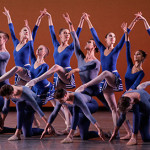
1. Alexei Ratmansky’s “Namouna, A Grand Divertissement”
 (Music by Edouard Lalo)
The first time I saw Alexei Ratmansky’s “Namouna”, I was caught off guard by its giddy love of 19th century ballet traditions. In his riotous ballet, Ratmansky takes conventions often associated with classical ballet (the traditional archetypes, the steps, the mime, etc.) and makes them broader and wittier than you’ve ever seen them. It’s less of a satirical gesture and more of a loving amplification of those traditions. At the same time, Ratmansky does away with the plot details (who really goes to the ballet for the plot?) and lets his joyous archetypes, as opposed to fleshed-out characters, explode over the stage sans filter. The result is a ballet of unbridled and satisfying exuberance that has not grown stale with repeated viewings (I’ve seen the ballet three times now). “Namouna” is a breathtakingly wild ride and a definite keeper for City Ballet.
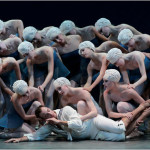
2. Justin Peck’s “Year of the Rabbit”
 (Music by Sufjan Stevens)
Of the three ballets, Justin Peck’s “Year of the Rabbit” may just be the most radical in its use of the corps de ballet. Indeed, the images Peck creates here are reminiscent of a more formal version (i.e., using classical ballet vocabulary) of Mark Morris’s iconic “L’Allegro”. Even more than Ratmansky’s “Namouna”, there is even less semblance of plot and definable characters in “Rabbit”. However, one associates the Roschach-like shapes and patterns that Peck inventively creates with objects we encounter in our every day lives (Wait, is that a road? A building?). Even the rhythmic score embraces both classical traditions and contemporary sensibilities: the music by indie music darling Sufjan Stevens was originally written as a piece of electronica but carefully re-orchestrated for orchestra by Michael P. Atkinson for the ballet. “Rabbit” is another exciting keeper of a dance for City Ballet, one which reveals new layers upon additional viewings.
3. Christopher Wheeldon’s “DGV: Danse à Grande Vitesse”
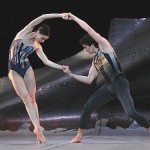 (Music by Michael Nyman)
The most unabashedly modern work of the three ballets is Christopher Wheeldon’s “DGV”, an exhilarating choreographic study of the notions of propulsion and glide. Indeed, this vision seems fitting given that Michael Nyman’s driving score was initially written for the inauguration of France’s high-speed rail system, the TGV. As you can imagine, with this work, we’ve taken a farther step (even more so than “Rabbit”) from plot-laden classical ballets into a more expressionistic realm. Despite this move towards lesser defined expressionism, I found it stimulating that Wheeldon decided to apply traditional ballet conventions (e.g., ladies are still en pointe) to articulate this expressionistic world. For me, the traditional ballet steps contribute to the work’s sleekness and smoothness, particularly in the “glide” sections, that I think would have been difficult to achieve otherwise. Kudos also must be given to designer Jean-Marc Puissant for his sleek, industrial settings and costumes that perfectly compliment Wheeldon’s invigorating choreography. Suffice to say, this one’s another keeper for City Ballet.
 Copyright © 2026
Leave a Reply