
VIEWPOINTS – Unconventional theatrical forms conveying inner lives: Hoi Polloi’s revival of Sarah Kane’s CRAVE, Mona Pirnot’s I BECAME WE
- By drediman
- October 29, 2026
- No Comments
When you sit down and think about it, what really is a “well-made” play? Most people will point to the wealth of examples from the likes of Shakespeare to Arthur Miller, which have been exhaustively emulated by generations of playwrights. As a frequent theatergoer, the regular intake of such formulaic concoctions can become predictable at times. Therefore, it’s often refreshing to come across theater-makers who have the rigor and experimental sensibility to use unconventional theatrical forms to convey the human experience. Here are two such recent instances by two daring playwrights, who do so with striking economy.
I BECAME WE
Atlantic Theater Company
Through November 15
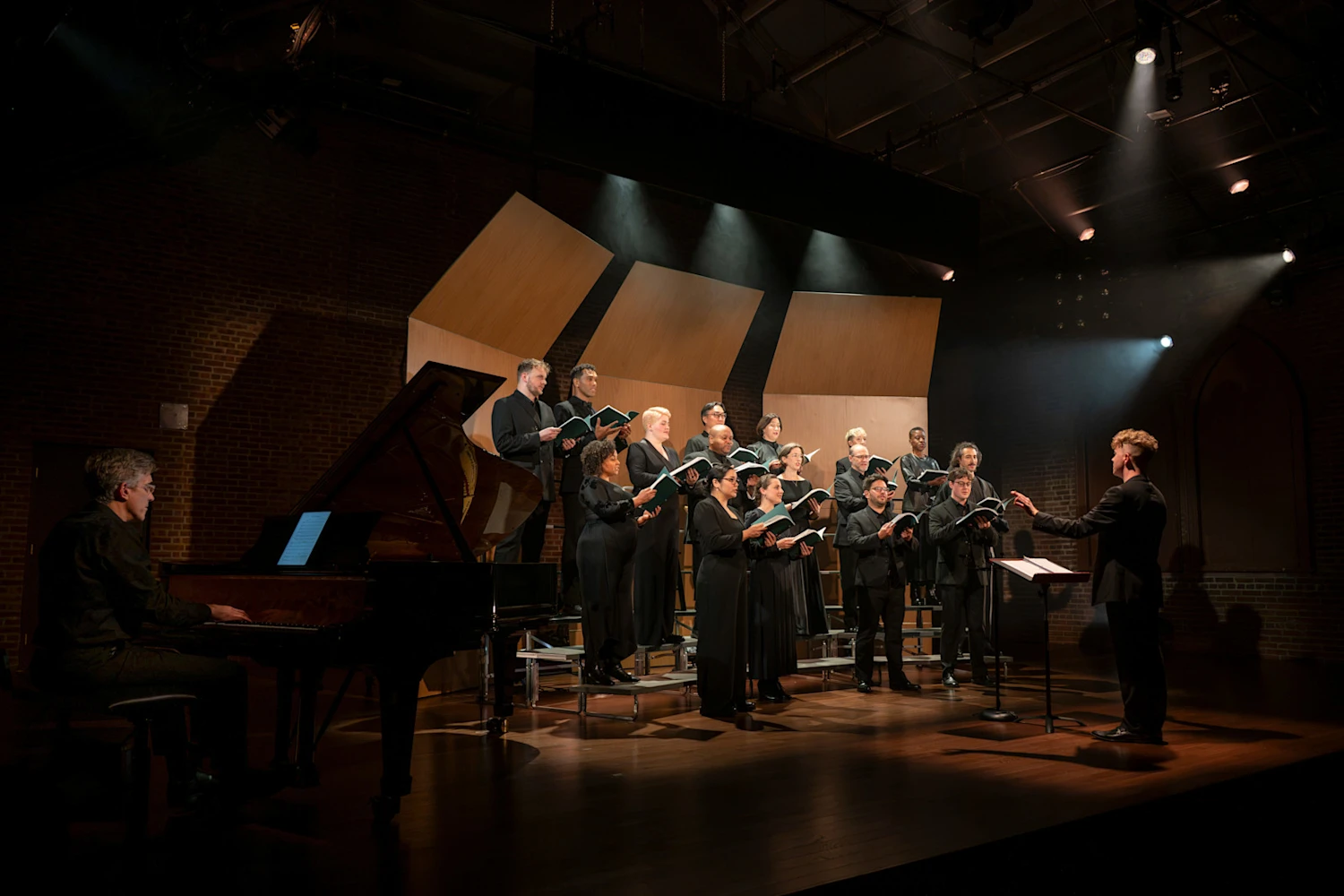
With such arresting works like I’m Assuming You Know David Greenspan and I Love You So Much I Can Die, Mona Pirnot has emerged in the last few years as one of our most fascinating theatrical voices. With her latest I Became We (HIGHLY RECOMMENDED) at Off-Broadway’s Atlantic Theater Company, Pirnot continues her cycle of autobiographical works, this time conveying her internal process in approaching life choices, namely purchasing a home and when/if to have a baby. Sans a visual representation of the playwright’s physical being, these inner thoughts are transmuted through into song by a chamber choir, who sing Pirnot’s stream of musings, including her doubts and fears, as well as a couple of interactions with her husband and mother. As beautifully composed by Jack D. Coen — who also music directs — the musical composition stays strictly in the classical choral music vernacular, although the lyrics (by both Pirnot and Coen) have a contemporary, unfussily direct, at times humorous quality that jarringly juxtaposes with the formality of the music. Its a calculated choice that results in the synergistic effect of connecting the mundane and everyday living with something much larger and spiritual, as if reaching out to the divine (choral music is often times associated with sacred/religious music). After all, the Atlantic’s Linda Gross Theater was a former church, which makes the experience of watching the show all the more resonant. Throughout, the tone is both mellow and vibrant, especially as warmly performed by the show’s top-notch, sixteen-member chamber choir and excellent pianist Blair McMillen. The compact, elegantly subdued production has been directed by Sarah Benson, who places the choir front and center, allowing their choral singing to shine through with unadorned clarity. As a piece of music theater, which I Became We certainly is, the work is a welcome and unique entry into a genre that’s been dominated for so long by predictably-written musicals.
CRAVE
Hoi Polloi at East Village Basement
Closed
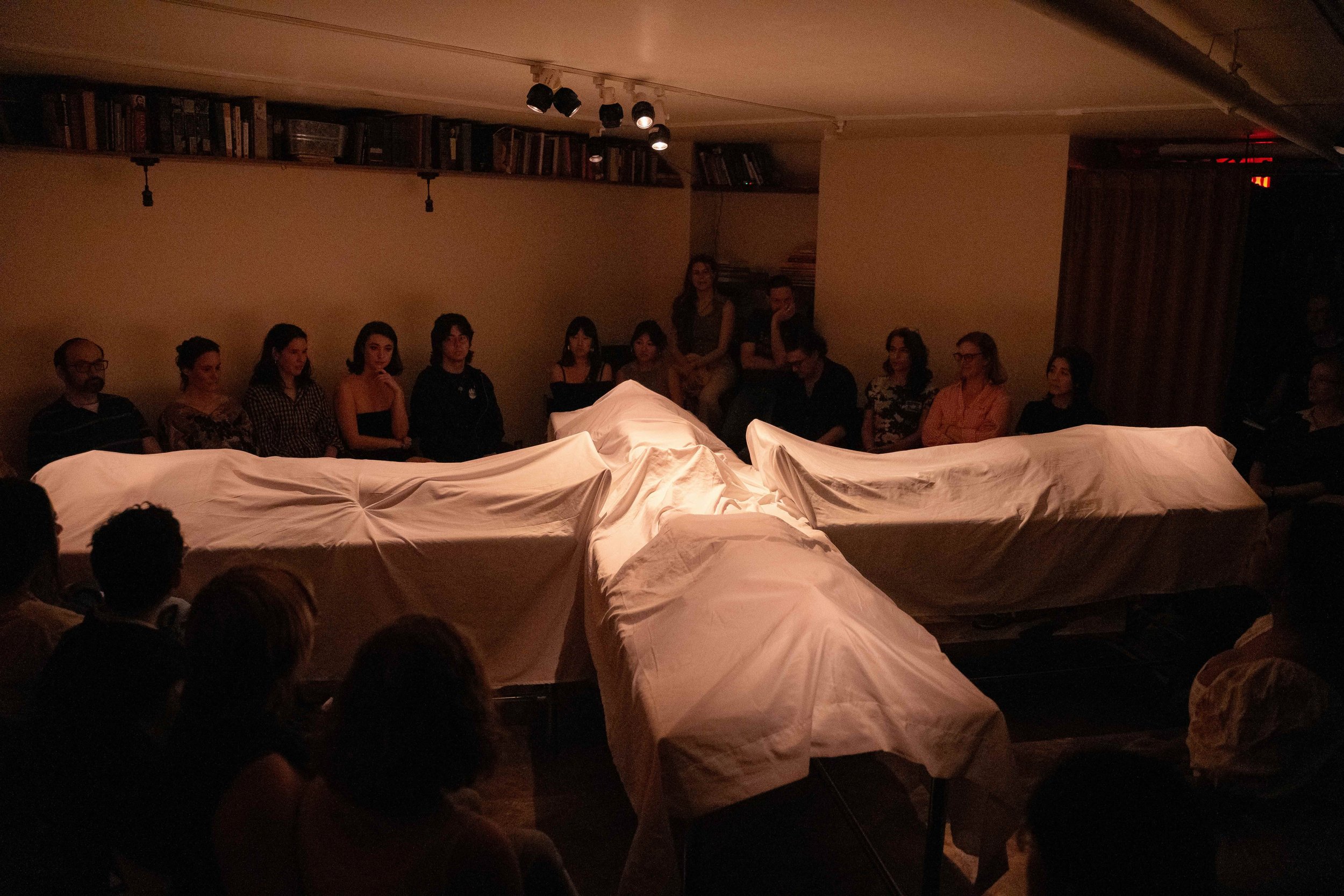
Watching a Sarah Kane play is one of the most treacherous and unnerving experiences in all of contemporary theater. As a playwright, she specialized in staring at humanity’s capacity for destruction and despair with unflinching steadfastness, almost to the point of fetishizing the darkness that lies within us. Among her plays, Crave (RECOMMENDED) – which Kane premiered under a pseudonym in 1998, less than a year before her untimely suicide in 1999 at the age of only 28 – strikes me as particularly appropriate for these anxious post-pandemic days, given the fraught and fractured psychological makeup of the four vaguely named characters — simply called A, B, C, and M — at the center of the unnerving, prismatic 50-minute play. Although they engage in (simultaneous) conversation, it’s not always clear to whom they are speaking or in what context. No doubt, Kane makes obvious nods to the disembodied theatrical works of Samuel Beckett, notably Not I. Thematically, one gathers that adultery, incest, loneliness, and suicide are among the struggles that are eating away at them. The only constant is the inconsolability that seethes from the stage. In Hoi Polloi’s exceedingly intimate and recently shuttered revival at East Village Basement — in which audiences seemed almost to be held captive, with no chance of escape — these four characters remained inextricably linked yet isolated from each other. Alec Duffy’s haunting, hyper-claustrophobic staging laid each actor, under white sheets as if corpses, on tables merely inches way from the audience. The proximity, alongside Steven Leffue’s subtle sound design, went a long way in magnifying the intensity of the characters’ disturbed psychological states. In largely catatonic physical performances, the well-rehearsed cast of four — Leah Del Rosario, Maggie Hoffman, Jonah O’Hara-David, and Julian Rozzell, Jr. — skillfully executed the complex, rapid fire dialogue, all the while navigating the constantly shifting emotional tone of the play with nuance. Collectively, they conjured something almost musical from the cacophony of Kane’s dialogue, a compelling counterpoint to the gorgeous unity of Pirnot’s I Became We.
 Copyright © 2026
Leave a Reply