
VIEWPOINTS – New plays that dramatize institutional houses of terror: Sophie McIntosh’s BENEVOLENT and Terence Anthony’s THE HOUSE OF THE NEGRO INSANE
- By drediman
- September 9, 2026
- No Comments
During this last gasp of summer — and segueing into a very busy fall theater season — I came across a pair of historically-based plays that each attempted to dramatize fictional happenings at institutional houses of terror. These would be Sophie McIntosh’s benevolent and Terence Anthony’s The House of the Negro Insane. As always, read on for my assessments of these pungent new works, both of which recently concluded their limited Off-Broadway runs.

BENEVOLENT
Good Apple Collective at IATI Theater
Closed
First up at IATI Theater in the East Village was Good Apple Collective’s production of benevolent(RECOMMENDED) by Sophie Mclntosh. Inspired by influential creations like Girl, Interrupted and John Proctor Is the Villain, the new play firmly falls into the category of works that attempt to shed revealing light on the growing pains of young women (some notable recent entries include Eliya Smith’s Dad Don’t Read This, Eliana Theologides Rodriguez’s Indian Princesses, and Ava Pickett’s 1536). That being said, benevolent maintains the playwright’s own uniquely macabre voice — which fearlessly juxtaposes adolescence and young womanhood with violence and conflict — keeping in line with her previous output like Macbitches and Road Kills. Set in 1917 in the pungent basement of Inwood Benevolent Home — a fictional women’s reformatory — the play depicts the stories of four young women who are relegated to the lowly duty of handwashing dirty laundry. Suffice to say, each character comes with their own bespoke backstory (no spoilers here) and love/hate relationship with the repressive reformatory facility as they endeavor to survive physically and psychologically. To McIntosh’s credit, the play unfolds in a nuanced and clear-eyed manner — thanks largely to the production’s quartet of committed, accomplished performances — despite its relatively predictable dramatic arc. Once again, Mclntosh has collaborated with director Nina Goodheart, who has done a wonderful job of conjuring a grimly atmospheric production with limited resources.
THE HOUSE OF THE NEGRO INSANE
The Negro Ensemble Company, Inc. at 59E59 Theaters
Closed
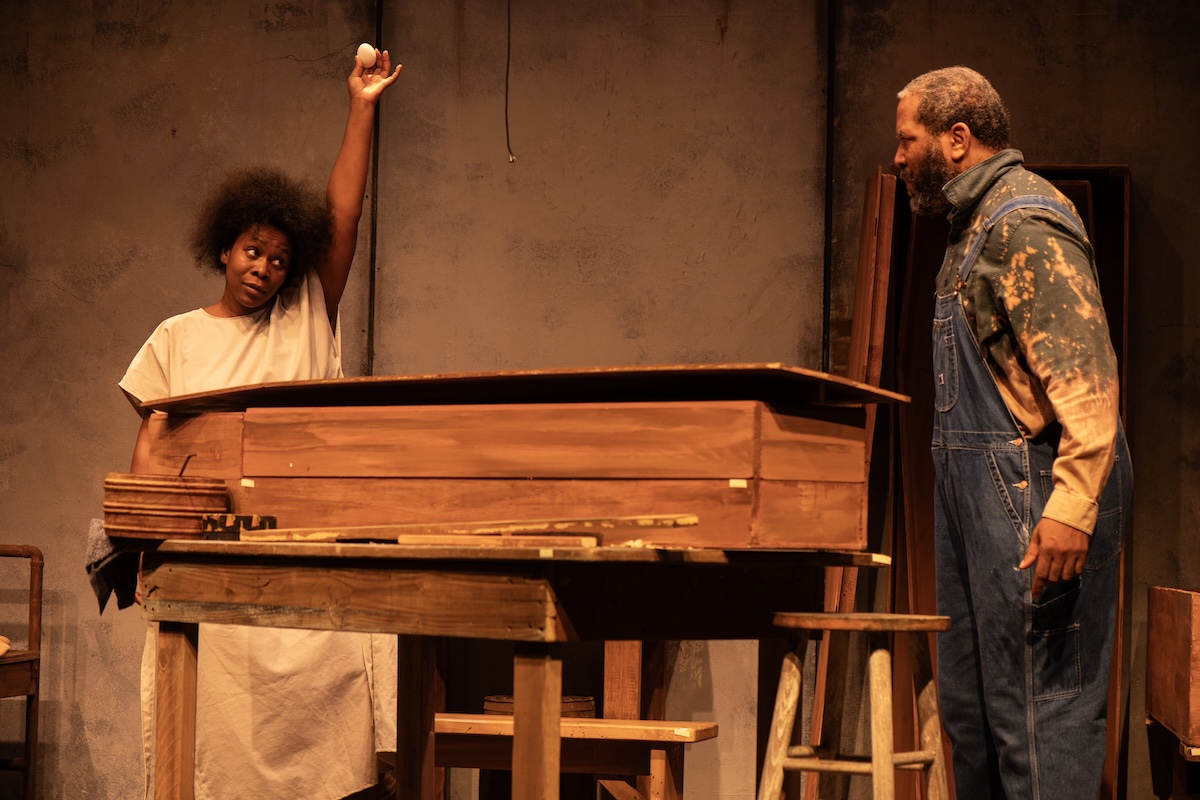
Then uptown at 59E59 Theaters, there was The House of the Negro Insane (RECOMMENDED) by Terence Antony. The play is set during the 1930s at a facility called Central State Hospital, a mental ward for Black patients, who are essentially tortured, abused, and held captive at the institution. The play, which was developed and presented by the Negro Ensemble Company, Inc., more specifically revolves around the wrongfully admitted character of Attius, a Black man who has spent time and effort working the system to allow him a tolerable — albeit macabre — existence as a coffin-maker (the show largely takes place in his workshop). Things take a turn when he gets involved with two patients on the run, the volatile Effie and the innocent Madeleine. It’ll come as no surprise that things don’t go to plan according for these characters (again, no spoilers here). Although Antony’s play is intermittently gripping and heavy-handed, there’s no denying that the premise is unique and fascinating. Like the aforementioned benevolent, The House of the Negro Insane is largely predictable, and some of the design elements of director Daniel Carlton’s intimate production — namely, sound and lights — are a bit clunky. Where the play shines are in its world building and precarious, often nail-biting dramatic conflicts, which give the play texture in its evocation of racism and survival. In terms of performances, Benjamin Rowe’s rock solid turn as Attius grounds the production, even when some of his fellow castmates veer towards histrionics.
 Copyright © 2026
Leave a Reply