
VIEWPOINTS – The enduring appeal of physical theater: Talking Band’s THE DOOR SLAMS, A GLASS TREMBLES and Pony Cam’s BURNOUT PARADISE
- By drediman
- May 14, 2026
- No Comments
There’s an honesty in the act of movement that has the potential to transcend the limitations of the human language, which probably explains the enduring appeal of physical theater, a genre of performance that has been a particular mainstay of downtown experimental theater. In recent weeks, I came across two such types of performances, each representing vastly different examples of the form. As always, read on for my thoughts.
THE DOOR SLAMS, A GLASS TREMBLES
Talking Band / La MaMa Experimental Theatre Club
Closed
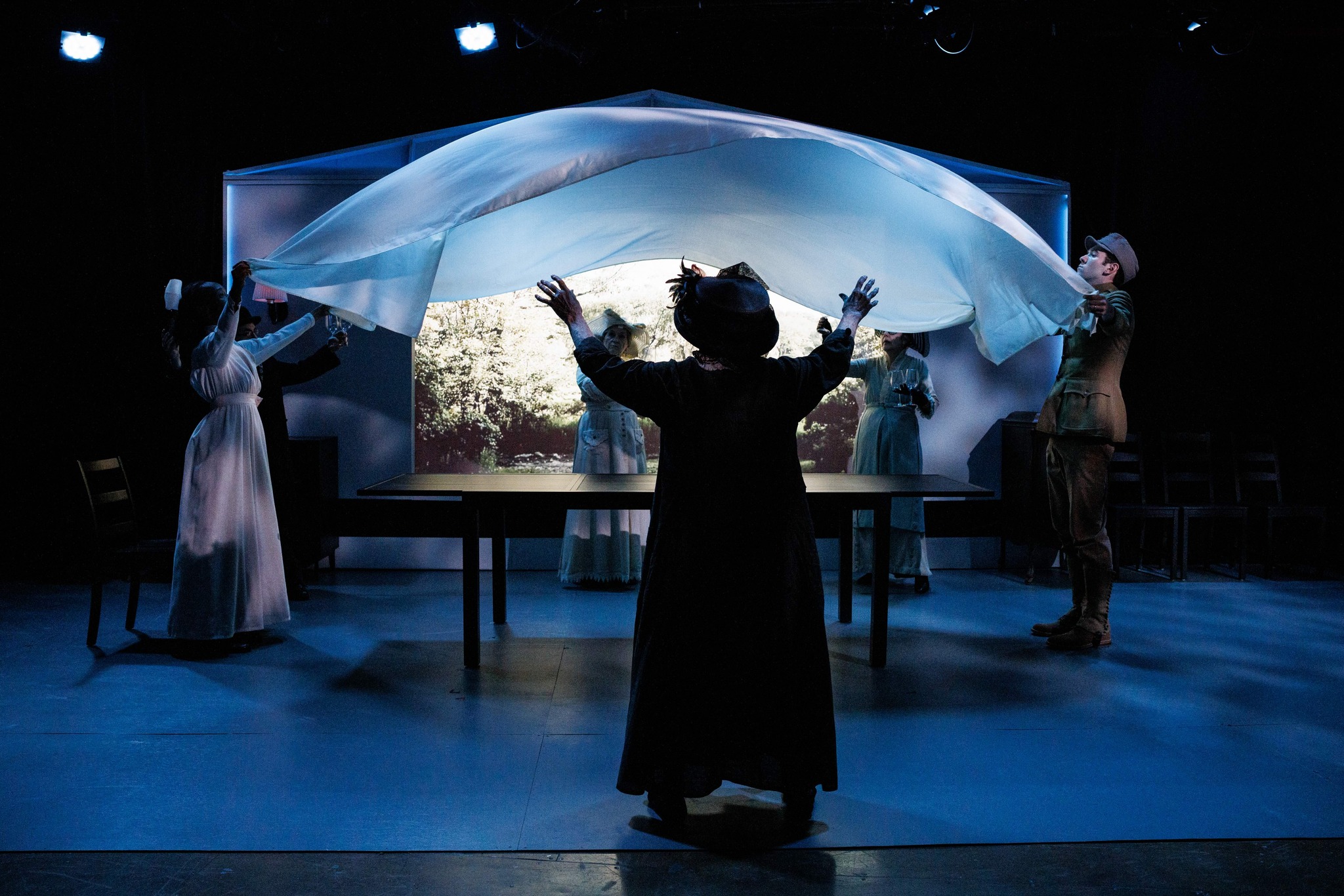
Before concluding its limited run this past weekend, I had the opportunity to catch a performance of Talking Band and La MaMa’s co-presentation of The Door Slams, A Glass Trembles (RECOMMENDED). Currently celebrating an astonishing 50 years of performance history, the prolific and acclaimed Talking Band has been one of the undisputed stalwarts of New York’s storied downtown avant-garde theater scene. In their latest, the company’s distinct aesthetic was evident throughout — think Chekhov meets Robert Wilson, with a pinch of the Wooster Group thrown in — with all the discipline and rigor you’d expect from such iconic theater-makers. Flannery Gregg’s meticulously calibrated, gestural movement vocabulary forms the backbone of the production, with every moment choreographed with charged purpose and careful attention to the resulting stage picture, creating a sort of lovely continuum across time and space — with the aid of veteran company member Ellen Maddow’s inquisitive and lilting pre-recorded score, as well as the flexible scenic design by Anna Kiraly — that flows from beginning to end. Like many of Talking Band’s mature output, the piece — which is written and directed by Paul Zimet, another longtime company member and Maddow’s partner — is more a reflective, stream-of-conscious meditation on the fabric of life than it is a clearly spelled out narrative. Specifically, it artfully contemplates the nature of time and the fragile way it intersects with memory, imagination, and our perception of the world, finding just as much profundity in the mundane (e.g., setting the table for a meal) as it does in “larger” life events (e.g., coming to grips with a death in the community). Although the work is primarily set in a country home in the Northeast, it dreamily also transports the audience to the deck a transcontinental ship, as well as a dining room in the Alps (as smoothly indicated by the Kiraly’s projections and Olivera Gajic’s elegantly suggestive costumes). Although the connection between these settings is tenuous at best, together they create gentle and lyrical tapestry that’s not quite as difficult to immerse oneself in as you’d think.
BURNOUT PARADISE
Astor Place Theatre
Through May 23
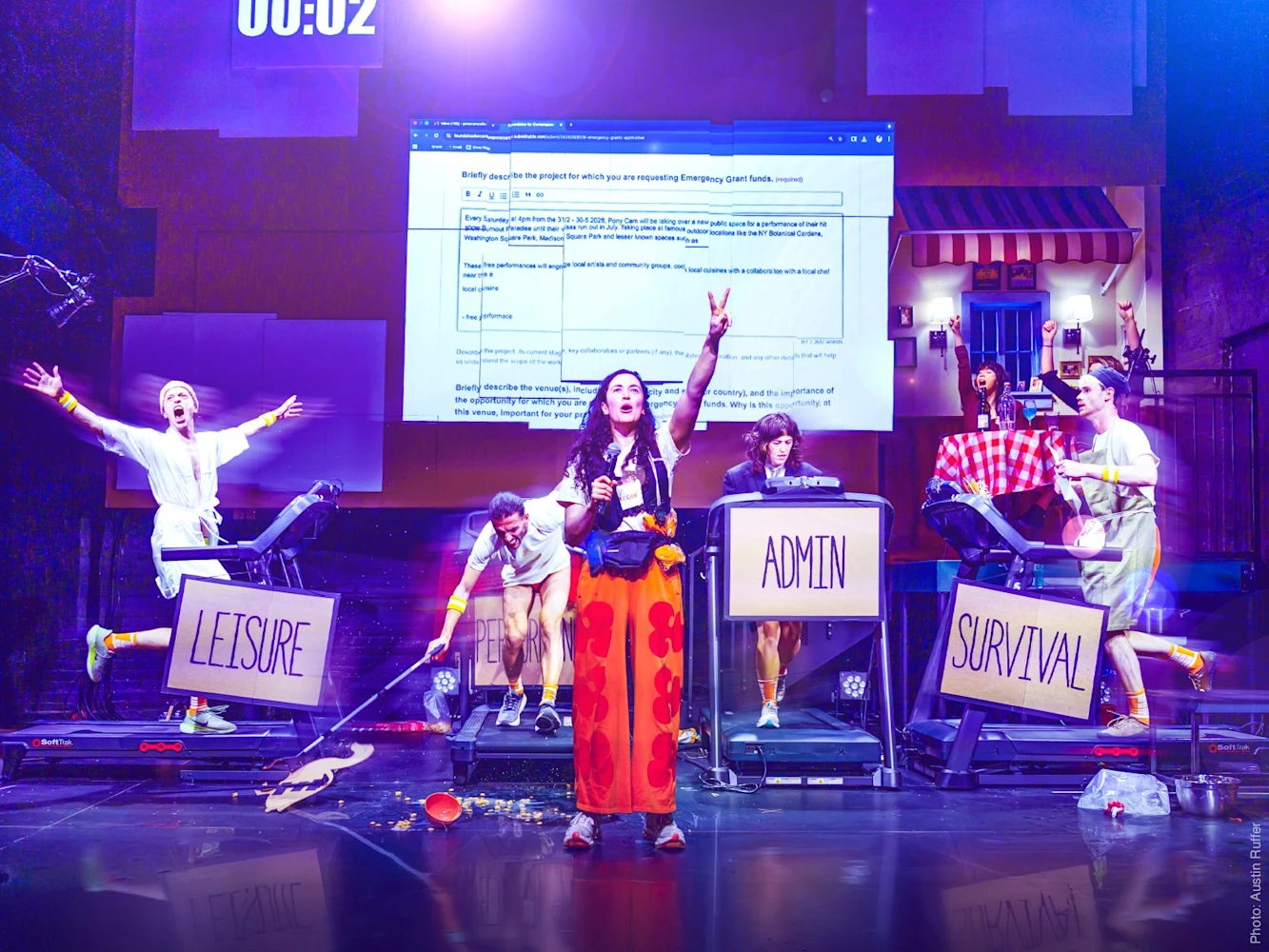
If you’re in the mood for something more unpredictable and viscerally inclined, look no further than Burnout Paradise (RECOMMENDED) at the Astor Place Theatre. Devised by the folks at Pony Cam — an Australia-based experimental theatre collective — the crowd-pleasing piece (which proved to be a hit earlier this year at the Edinburgh Fringe Festival) is a chaotic, admittedly gimmicky, and altogether smashingly entertaining display of endurance, creativity, and immersive community-building. Over the course of the evening, four members of the company — Claire Bird, William Strom, Dominic Weintraub, and Hugo Williams — metaphorically challenge themselves, for just over an hour, to lead balanced lives across various aspects of modern living, namely Survival, Admin, Performance, and Leisure. Upon first glance, Burnout Paradise offers little in terms of serious food for thought. Indeed, the immediate payoff is the entertainment derived from the escalating hilarity and competitive tension that ensues (I can safely guarantee with certainty that no two shows are alike). More specifically, these involve cooking and serving a three-course meal (to two willing audience members!), campaigning for the arts, enacting ludicrous performance art pieces, and performing a high volume of random leisurely tasks (e.g., going trick-or-treating, getting a massage, waxing hair, etc.) — all the while running on treadmills (!), the act of which represents the relentless hustle of our everyday existence. But it’s not all empty calories, however. In its encouragement of audience participation to accomplish these tasks, the piece creates an intrinsically communal experience, in the process going a long way in restoring faith in people and our ability to accomplish things together. As such, it conjures a sort of utopic vision while holding a mirror to the audience — is this really what modern life has become? If so, we are on the fast track to unsustainability, as manifested by endgame for the evening’s four fearless performers, who by the end of the evening, have literally pushed themselves to the point of physical and creative exhaustion.
 Copyright © 2026
Leave a Reply