
VIEWPOINTS – Hell is (the lack of) other people, according to THE CHRISTIANS and FULFILLMENT
- By drediman
- October 12, 2015
- No Comments
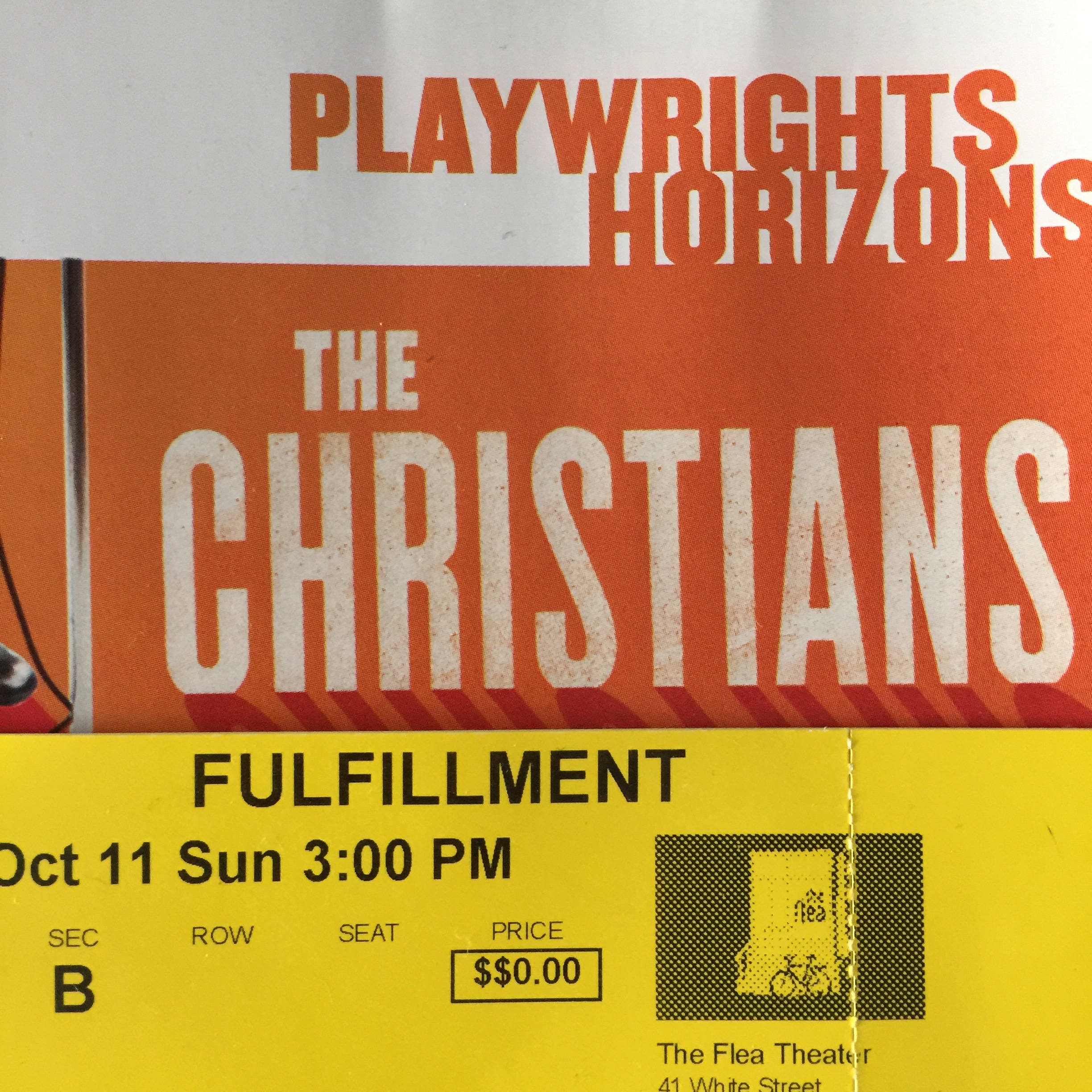 This past weekend, I caught two new fascinating if uneven plays Off-Broadway. The Christians, Lucas Hnath’s sensitive new play at Playwrights Horizons, tells the story of Paul, the pastor of a fictitious megachurch, who creates a rift in his congregation when he preaches that hell does not exist and that its only form is here on earth. Suffice to say, this rift widens and all but devours the parish and Paul (truthfully played by Andrew Garman with heartbreaking anguish). Down at the Flea, Thomas Bradshaw’s latest, the aggressive Fulfillment, tells the story of Michael, a corporate lawyer whose life unravels as forces out of his control conspire against him. Let’s just say Michael’s (given life by a smartly accessible everyman portrayal by Gbenga Akinnagbe) downward spiral starts when he purchases a pricey Soho condo, which has one small problem – a noisy, problematic upstairs neighbor. Although these plays couldn’t be more different in style and philosophy, notions of man’s capacity for tragedy, religion, morality, and hell (even economics and finance) course through both their veins. Viewed and assessed together, they make compelling companion pieces.
Pastor Paul’s belief that hell only exists here on earth is one that Fulfillment basks in. Mr. Bradshaw’s play runs with this idea and shows us a world that’s bleak and terrifying, especially for Michael. It’s a world of loose moral grounding in which baser instincts reign and the inevitability of the horrors of life is the only thing we can count on. People in relationships cheat on each other. Children are struck by cars. Men get assaulted and beaten in their own homes. Miscarriages are the norm. Relapses into bad habits aren’t surprising. Sex trumps prayer. Talk is cheap. People are judgmental or just plain assholes. It’s quite the jungle out there, Mr. Bradshaw unsentimentally and coolly tells us – shit happens all the time because we’re more primal and selfishly uncaring than civilization leads us to believe. Therefore, there is no rhyme or reason for Michael’s fall from grace; he is just dealt the wrong cards. I like to think of Fulfillment as more of a parable (perhaps one that Pastor Paul could use to illustrate “hell on earth” to his congregation?) than a worldview. If you ascribe to the latter, then oh my, you’re all in for a wild, senseless ride.
On the contrary, Mr. Hnath is more hopeful in his portrayal of humans as higher beings. Unlike the characters in Fulfillment (for whom religion is merely a coping mechanism that can be pulled out anytime it’s helpful and convenient), the characters that populate The Christians have a deeper sense of morality and identity, as determined by their religious beliefs. That’s why when Paul announces his radical newfound belief system to his congregation, the tremors that emanate are more thunderous than any thump – however disruptive and unnerving – Michael’s obnoxious upstairs neighbor can muster (big kudos to Fulfillment sound designers Mikhail Fiksel and Miles Polaski, by the way). When Paul has subsequent discussions with members of his flock, including his own wife (but particularly the dialogue he undertakes with his associate pastor, Joshua, as well as a struggling young choir member), one gets the sense that their very souls are quietly at stake. When his congregation starts leaving him, one by one, it’s as deeply disconcerting to watch as Lear’s descent into decrepitude and madness. For Paul, this is hell – the loss of his congregation and potentially even his family (in short, the lonely life). By design, Michael’s demise in Mr. Bradshaw’s world – in which hell is other people – by comparison feels as random and meaningless as watching a victim succumb in a second rate zombie flick. In either case, Sartre would be proud.
Although both are worthwhile, thought-provoking productions, neither is perfect. Some scenes in Mr. Bradshaw’s Fulfillment feel forced and heavy-handed – even unnecessary – especially without his usual shock jockey antics to distract us (Fulfillment, although it may shock some, is not nearly as extreme or subversive as his previous plays). And given the play’s insistent bleakness, an overarching two dimensionality quickly settles in that makes some stretches unavoidably tedious, even with the play’s relatively short 90 minute running time. However, director Ethan McSweeny does well to capture the staccato rhythms – thanks in large part to Mikhail Fiksel’s tense, restless music – and forward momentum of Mr. Bradshaw’s play, even on the Flea’s incredibly wide stage. Although I cherish The Christians’ thoughtful, well-balanced debates, I have some reservations regarding its current presentation at Playwrights Horizons. Its hyper-realistic depiction of a Sunday service early in the play (the detailed set design is by Dane Laffrey) doesn’t gracefully and convincingly transition to the more stylized sections deeper in the play. Here, I think I’d blame the director (Les Waters) more than the playwright. Simply speaking into a microphone doesn’t cut it.
(BOTH) RECOMMENDED
THE CHRISTIANS
Off-Broadway, Play
Playwrights Horizons
1 hour, 30 minutes (with no intermission)
Through October 25
FULFILLMENT
Off-Broadway, Play
The Flea
1 hour, 30 minutes (with no intermission)
Through October 19
 Copyright © 2026
Leave a Reply