
VIEWPOINTS – This spring, Ibsen’s legacy permeates New York stages
- By drediman
- June 8, 2016
- No Comments
Late in this spring season, New York has come alive with plays by or inspired by Henrik Ibsen. Classic Stage Company is in the midst of a run of the rarely-performed and controversial early Ibsen classic Peer Gynt. Across the East River at Theatre for a New Audience, theatergoers have a chance to catch yet another A Doll’s House, which is being performed in repertory with August Strindberg’s The Father – a play Strindberg wrote in reaction to A Doll’s House. The spring season also saw the premiere of Penelope Skinner’s The Ruins of Civilization, courtesy of Manhattan Theatre Club. Ms. Skinner’s play, set in a dystopian future, clearly draws from Ibsen warhorses like A Doll’s House and Hedda Gabler.
Ibsen’s early-career PEER GYNT at CSC continues to confound
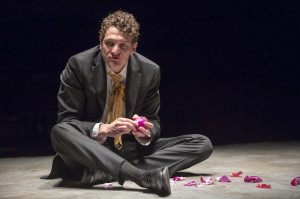 In the history of Western theater, there’s nothing quite like Ibsen’s 1876 Peer Gynt, a sprawling – and utterly confounding – epic about one man’s journey through life. I would argue that shows like Stew’s current The Total Bent at the Public was inspired by Ibsen’s loose-limbed, fever dream of a play. In this early-career endeavor, Ibsen drew from both his own life, as well as Norwegian folklore, to come up with a piece of theater that many consider unwieldy. Indeed, performances of the hallucinatory Peer Gynt, which Ibsen also wrote in verse, can last upwards of five hours in duration across five grueling acts.
On paper, Classic Stage Company’s incoming artistic director, John Doyle, seems just the right man for the assignment. Mr. Doyle is currently represented on Broadway with his stunning, stripped-down revival of The Color Purple, which improves dramatically on Gary Griffin’s lavish original production by focusing and strongly shaping Celie’s eventful journey. In his Peer Gynt, Mr. Doyle applies the same minimalism and judicious cutting (the play now runs a still-grueling intermission-less two hours) that he’s known for.
The results are decidedly mixed. Many audience members coming to the piece for the first time will leave scratching their heads. That’s because Mr. Doyle’s minimalism mutes and even disregards the some important details in the plot (despite some fascinating “sweeping” imagery) – characters become frustratingly indistinct and a monotonous dullness sets in after the first half hour. The CSC production, however, does feature a heroic performance from the talented Gabriel Ebert (a Tony winner for his performance as Mr. Wormwood in Matilda), who brings restless energy and existential angst to the the titanic title role.
SOMEWHAT RECOMMENDED
At TFANA, Ibsen’s A DOLL’S HOUSE coexist Strindberg’s THE FATHER
Over at Theatre for a New Audience, the excellent classical director Arin Arbus explores devolving marriages in two plays by the giants of Norwegian theater: Ibsen’s A Doll’s House and Strindberg’s The Father. Both productions are sensational, and definitely worth a trip out to Brooklyn.
 With his sharply-drawn revival of the much-performed A Doll’s House, Mr. Arbus is once again proving that Ibsen is alive and well in New York. It’s shocking to believe that A Doll’s House’s much-documented naturalism comes from the same playwright who brought us the surreal mess that is Peer Gynt (especially when these productions are seen in close succession, as I did). It’s refreshing to come across a production of A Doll’s House that’s straightforward and staged with clarity, as it is here (in a well-worn adaptation by Thornton Wilder), without the flashy directorial overlays that such classic plays are subject to these days – you know it’s only a matter of time until Ivo van Hove gets his hands on this Ibsen warhorse. As that feminist prototype, Nora Helmer, Maggie Lacey gives a beautifully calibrated performance that’s deceptive in its accessibility. Ms. Lacey draws you in with her easy charisma, only to devastate you with Nora’s uncompromising, clear-eyed decision at the play’s conclusion. As Nora’s condescendingly overbearing husband, Thorwald Helmer, the great John Douglas Thompson shows his considerable range in a role that’s unlike the larger-than-life roles he’s been associated with (remember his towering Tamburlaine at TFANA last season?). This production’s final stage picture, in which Mr. Thompson’s Thorwald is left to tend his children, stunned and terrified, is one of the memorable images of the season.
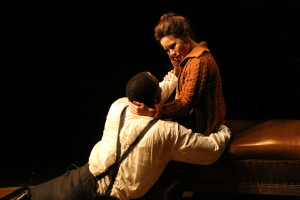 Stridberg famously wrote The Father in retaliation to A Doll’s House‘s popularity and perceived feminist importance, particularly the simplistic view that women are no more than helpless victims. In The Father, Strindberg intriguingly inverts the table and suggests that deteriorating marriages are likely the result of both parties involved. Hence, The Father plays out more like a battle royale than the domestic drama of A Doll’s House, especially in David Greig’s insightful new adaptation, which manages to be both strikingly contemporary without betraying Strindberg’s intended setting. As with his production of A Doll’s House, Mr. Arbus stages The Father with uncanny clarity and an innate – yet unforced – sense for escalating stakes. the dueling couple of Laura and the Captain are once again brought to life by the wonderful Ms. Lacey and Mr. Thompson, respectively. Both bring a fierce intelligence to their roles, and it’s fun to see the same actors take on what is essentially the same scenario but with a different balance in power.
HIGHLY RECOMMENDED (both productions)
MTC’s production of THE RUINS OF CIVILIZATION by Penelope Skinner places Ibsen in a dystopian future
 Uptown at New York City Center, courtesy of Manhattan Theatre Club, I caught a performance of the recently-shuttered The Ruins of Civilization by Penelope Skinner. The up-and-coming Ms. Skinner, who’s sex-focused play The Village Bike impressed me tremendously last season, here gives us a A Doll’s House of sorts set in a vaguely familiar dystopian future. The play once again tells the now familiar story of an overbearing husband and his long-suffering, victimized wife. Indeed, more than 130 years after Nora’s famous door slam was first heard, Ibsen – and A Doll’s House – continues to permeate our conception of theater, as this latest riff clearly proves. Even if her latest play doesn’t quite possess the subtle nuances and complexities of A Doll’s House or even Ms. Skinner’s previous The Village Bike, The Ruins of a Civilization is nevertheless a very well-crafted play that’s been given a solid production by director Leah C. Gardiner.
The acting is mostly very good. Perhaps the strongest performance of the production’s quartet of actors come from Tim Daly and Roxana Hope. Mr. Daly plays Silver, the overbearing husband part, in a performance that’s just perfectly realized; you just love to hate his Silver. The radiant, intensely present Ms. Hope doesn’t play the “Nora” role, but instead shines as the foreign interloper who inadvertently brings about the marriage’s demise. I ultimately found Rachel Holme’s Dolores (i.e., Nora) a bit grating, but I attribute much of this feeling to Ms. Skinner’s writing. Of the heroines in the bunch, Dolores is the most backwards – which is ironic given the play’s futuristic setting.
RECOMMENDED
PEER GYNT
Off-Broadway, Play
Classic Stage Company
2 hours (with no intermission)
Through June 19
A DOLL’S HOUSE
Off-Broadway, Play (playing in repertory with The Father)
Theatre for a New Audience
2 hours, 10 minutes (with one intermission)
Through June 12
THE FATHER
Off-Broadway, Play (playing in repertory with A Doll’s House)
Theatre for a New Audience
1 hour, 45 minutes (with no intermission)
Through June 12
THE RUINS OF CIVILIZATION
Off-Broadway, Play
Manhattan Theatre Club at NY City Center
2 hours, 15 minutes (with one intermission)
Closed
 Copyright © 2026
Leave a Reply