
VIEWPOINTS – London roundup: A varied bounty of performances across the classics, new dramas, musicals, and beyond
- By drediman
- December 31, 2025
- No Comments
A few weeks back, I was able to travel across the pond to take in an eclectic bounty of shows across the classics, new dramas, musicals, and beyond to satisfy my craving for London theater and the broader performing arts. As per usual, read on for my thoughts on yet another successful trip to one of the world’s theater capitals.

THE CLASSICS
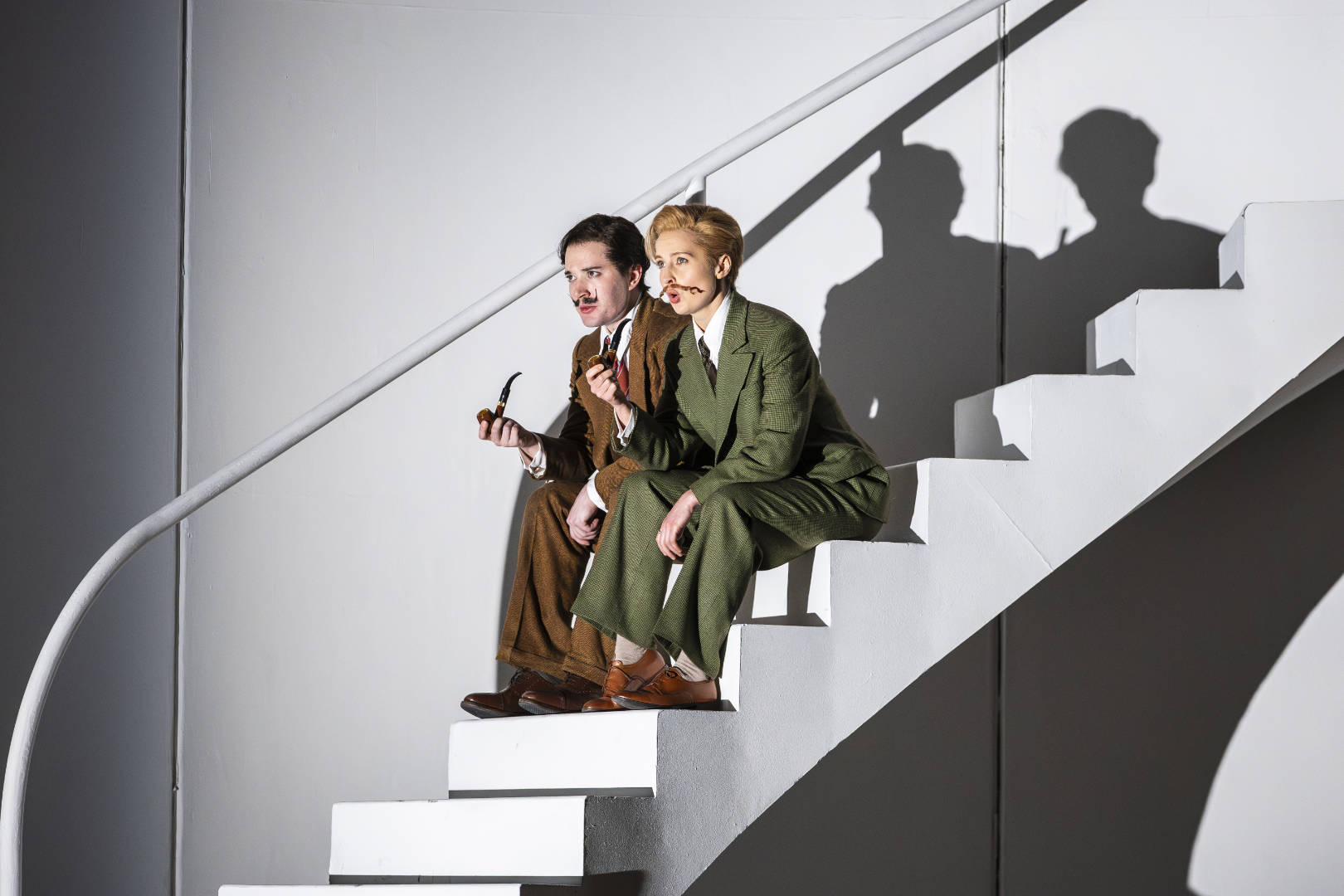
Perhaps the most striking aspect of my theatergoing in London were the forward thinking revivals that I encountered, all of which brought new textures and perspectives to classics I thought I knew. First and foremost is the National Theatre’s production of Oscar Wilde’s The Importance of Being Earnest (HIGHLY RECOMMENDED), which has transferred to the West End’s Noël Coward Theatre. Fully embracing the pregnant queer subtext that permeates Wilde’s play, director Max Webster has amped up the camp to its maximum level, in the process altering the cadence of the well-worn work to allow it to literally blossom into a garishly off-the-wall farce (reminiscent of Cole Escola’s current Broadway and now West End hit as Oh, Mary!). Led by the great Stephen Fry as Lady Bracknell, the sparkling revival features genuinely giddy performances that chew up the scenery and had me in stitches from the get go. Then over at the atmospherically candle-lit Sam Wanamaker Playhouse at Shakespaere’s Globe, you’ll find a uniquely sinister take on the Bard’s A Midsummer Night’s Dream (RECOMMENDED). As stylishly directed by Headlong’s Holly Race Roughan, the pointedly acted production uses a chilly yet sleekly referential visual aesthetic to take this most popular of Shakespeare’s comedy awfully close to the realm of tragedy, both in terms of context and interpretation. In particular, the audacious final scenes render this dream more like a living nightmare than anything else (no spoilers here), even if they don’t quite add up in hindsight. Largely leaning in on ensemble-style storytelling, the production nonetheless casts a dark spell that’s both mesmerizing and disorienting. Finally, at the small but mighty Donmar Warehouse in Covent Garden, I was able to catch one of the final performances of Kip Williams’ bold revisal of Jean Genet’s The Maids (HIGHLY RECOMMENDED). Williams made a notable splash with his video-heavy stage adaptation of Oscar Wilde’s The Picture of Dorian Gray, which was ultimately brought to Broadway winning its star Sarah Snook a deserved Tony Award for her performance. His equally multimedia-focused production of Genet’s absurdist potboiler is fully immersed in the modern age, taking themes inherent in the work and smashing them with the implications of the digital age endgame game we are all fast headed towards. It’s a roller-coaster of a ride that boasted three of the most visceral and caustic performances I saw on my trip.
NEW DRAMAS
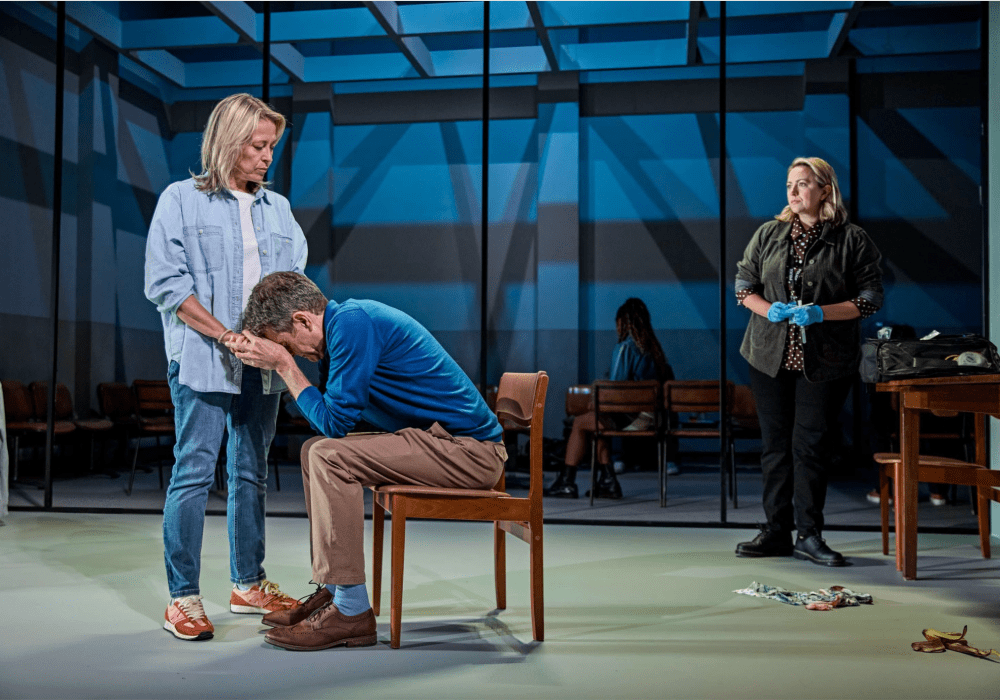
Not quite as wholly captivating as the aforementioned revivals were the finely-acted, largely thought-provoking new dramas that I was able to catch, starting with the Royal Court’s production of The Unbelievers (RECOMMENDED) by Nick Payne (on Broadway, the writer of the Jake Gyllenhaal vehicles Constellations and Seawall/A Life). In short, the new play is a portrait of Miriam, a woman who refuses to accept the death of her teenage son, even years after he has gone missing. As played with astonishing intensity and rage by stage veteran Nicola Walker, the grieving and arguably mentally unstable Miriam retaliates with all of her being against those around her, most of whom are desperate to move on from the unspeakable tragedy but are drawn back to it by her immense grief and sheer force of will. In one of her more unflashy recent efforts — not necessarily a bad thing — auteur director Marianne Elliott stares straight into Miriam’s turbulent soul, only to reveal its contradictions and unfathomable depths. Then there were a pair of satisfactory new works by playwright David Eldridge. The first of these is the West End transfer (from the Chichester Festival Theatre) of his adaptation of John le Carré’s The Spy Who Came in from the Cold (RECOMMENDED), which has the distinction of being the first book by the famed espionage novelist to be re-envisioned for the stage. Even if le Carré’s seminal tale is showing its age in terms of themes and narrative machinations, Eldridge has nonetheless distilled the work into an engaging and efficiently plotted piece of theater. As immersively staged in-the-round at @sohoplace by Jeremy Herrin, the noir-soaked production is decidedly (and refreshingly) old-fashioned, featuring a muscular, no-nonsense quality that befits the material. At the center of it all is Rory Keenan’s committed performance as a retired World War II spy who gets re-entangled in the web of intrigue of his past. Then over at the National Theatre’s Dorfman Theatre is the new two-hander End (SOMEWHAT RECOMMENDED), the final installment of Eldridge’s three play chronicle of one British couple’s journey through the entire life cycle of their relationship and marriage. Although Clive Owen and Saskia Reeves give brave and affecting performances as a coupe dealing with the realities of terminal cancer in their union, the one-act play ultimately comes across as somewhat contrived and emotionally manipulative, neatly packaging what is a devastatingly complicated and harrowing episode in anyone’s life.

MUSICALS
No trip to London would be complete without a number of West End musical theater outings. Chief among these is the current revival of Oliver! (RECOMMENDED), which continues to go strong at the Gielgud Theatre. Director and choreographer Matthew Bourne has placed the musical in a darker, more dangerous world than you’re probably used to, which gives this production of the Lionel Bart classic — adapted from Dickens, of course — a grungy grittiness that’s seemingly lifted straight from Les Misérables (which continues its record-breaking run next door at the Sondheim Theatre). Indeed, the star here is the staging, which is superbly blocked and organically builds into and out of the musical’s numerous eye-popping production numbers (“It’s a Fine Life”, “Consider Yourself”), while maintaining a sense of depth and a world teeming with life. Of the performances, Simon Lipkin stood out, putting over a dynamically robust and uncommonly sexy portrayal of Fagan. Over at the Garrick Theatre, you’ll find the West End transfer of the Menier Chocolate Factory production of Mel Brooks’ The Producers (RECOMMENDED). Leaner and meaner than the original production that played Broadway (which was directed by Susan Stroman and garnered a record-breaking 12 Tony Awards), Patrick Marber’s version focuses squarely on the delirious outrageousness of the material, highlighting the sturdiness of the musical’s construction and the inspired hilarity of Brooks’ comedic writing. In the process, Marber — who is largely known for penning and directing serious dramas (e.g., Closer, Leopoldstadt) — has elicited some nuanced and sharply-etched performances, namely from Andy Nyman, Marc Antolin, and Trevor Ashley, who incisively put their own mark on the roles of Max Bialystock, Leopold Bloom, and Roger DeBris, respectively. Although a part of me thought I would miss the spectacle of Stroman’s staging going into the show, I actually didn’t at all, which is a testament to the care and attention to detail of Marber’s production. Although not technically a musical, I’ve put Conor McPherson’s adaptation of The Hunger Games: On Stage (RECOMMENDED) in this category because of its sheer scale and inclusion of not an insignificant amount of music as a storytelling device. Staged in a specifically-built arena in Canary Wharf, Matthew Dunster’s production is an immersive spectacle that faithfully recreates the first book of Suzanne Collins’ popular series for the stage. Although McPherson valiantly attempts to bring intimacy and grounded humanity to the proceedings, often times the intimidating size of the endeavor squashes the playwright’s efforts. Overall, it’s an admirable achievement that should appease fans of the books/movies, if not necessarily make new converts. Obviously I missed Paddington: The Musical, but I figured that that show would likely to run at the Savoy Theatre for at least a decade, leaving me plenty of opportunities to see it during one of my future trips.
OPERA AND DANCE
Beyond theater, I was also able to take in performances in the realms of opera and dance (well, sort of, which you’ll find out more about below). First up was English National Opera’s production of Handel’s rarely performed opera Partenope (HIGHLY RECOMMENDED). Originally staged by director Christopher Alden in 2008 to Olivier Award-winning effect, the production returned for an autumn run at the London Coliseum, where it proved to be an intoxicating concoction. Seemingly set in 1920s Paris, Alden’s stylish production is a heady look at desire, warfare, and love. It’s a bold resetting and a surreal spin — the production all but does away with the opera’s convoluted original plot — which brilliantly and poignantly illuminates the humanity of the piece, as well as the many absurdities that accompany life’s journey. At the heart of it all is Handel’s brilliant score, which was spiritedly conducted in the pit by William Cole (ably filling in for an ailing Christian Curnyn), who made a strong case for the work belonging in the regularly performed operatic repertoire. Throughout, the singing and acting were captivating and alive, led by an alluring and seductive Nardus Williams in the title role. Although some may find Alden’s overall conceit confusing — particularly in light of the opera’s original world building — I found it to be an invigorating example of the art form’s capacity for sophistication and elasticity, as well as its emotionally piercing ability to cut to heart of the human experience. Then there’s Wayne McGregor’s hypnotic and hyper-immersive film On the Other Earth (RECOMMENDED), the renowned choreographer’s fascinating juxaposition of dance and technology, namely artificial intelligence. Screened at Stone Nest, the ultra high definition 3D film (which uses the same impressive video technology that brought ABBA Voyage to show-stopping, reality-blurring life) envelops the audiences as dancers from McGregor’s company and members of the Hong Kong Ballet take us to an improbably organic imagining where human connection and technology are intrinsically intertwined. Although the project may strike some dance fans as a bit too abstract, I found it to be rather exciting and visionary. If you’re like me, then I would also recommend that you pair the experience with McGregor’s Infinite Bodies exhibit at Somerset House, which further investigates the British choreographer’s boundary-pushing musings.
 Copyright © 2026
Leave a Reply