
VIEWPOINTS – New York City Ballet fall company premieres: Jamar Roberts’ FORESEEABLE FUTURE and Justin Peck’s HEATSCAPE
- By drediman
- October 14, 2025
- No Comments
This just-concluded fall season, New York City Ballet presented a pair of eagerly anticipated premieres from two high profile American choreographers — the world premiere of Jamar Roberts’ Foreseeable Future and the company premiere of Justin Peck’s Heatscape. Read on for my assessment of these works, both of which were programmed alongside other contemporary ballets from City Ballet’s vast repertory.
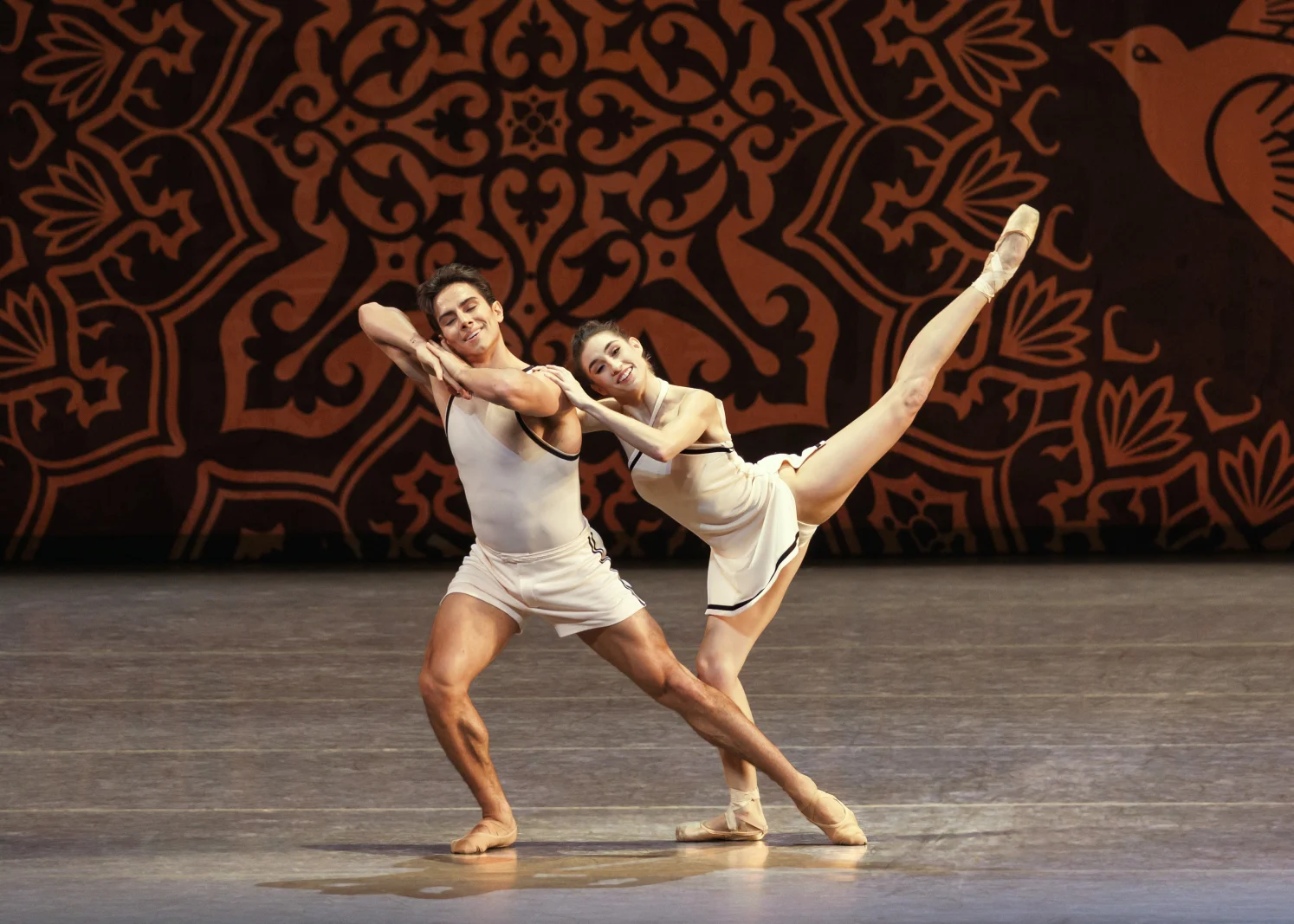
Seeing Justin Peck’s Heatscape (RECOMMENDED) for the first time in its New York City Ballet premiere this fall was, ironically, like spending time with an old friend. That’s because the piece is strongly reminiscent of some of Peck’s most beloved ballets, namely Year of the Rabbit, Rodeo, and Everywhere We Go. This shouldn’t come as a surprise given that the piece was created ten years ago in 2015 — the ballet was originally commissioned by Miami City Ballet — around the time he choreographed the aforementioned pieces for City Ballet. No one can deny the masterful construction of Peck’s kaleidoscopic architecture for the satisfying 30-minute ballet, nor the bright exuberance with which he launches his dancers, with both freedom and tension, to Martinů’s high-spirited First Piano Concerto. Indeed, Heatscape is full of youth and even convincing humanity, the latter being a relatively uncommon descriptor for Peck works (in this respect, the work particularly draws favorable comparisons to Rodeo, which was choreographed in the same year). Also worth commending are the intricately patterned backdrop by Shepard Fairey and the tastefully subdued costumes by Reid Bartelme and Harriet Jung. Particularly stunning was principal Miriam Miller — partnered ably by Peter Walker — who performed with regal authority and presence. Younger dancers like Jules Mabie, David Gabriel, Naomi Corti, and Dominika Afanasenkov (the latter two were deservedly promoted to soloist status last week) also shined, dancing with sunny dynamism and unforced style. Peck’s ballet was performed with Gianna Reisen’s pretty but unmemorable Signs (2022), Ulysses Dove showily crowd-pleasing Red Angels (1994), and Peter Martins’ derivative pas de deux Zakouski — it was easily the best of the bunch.
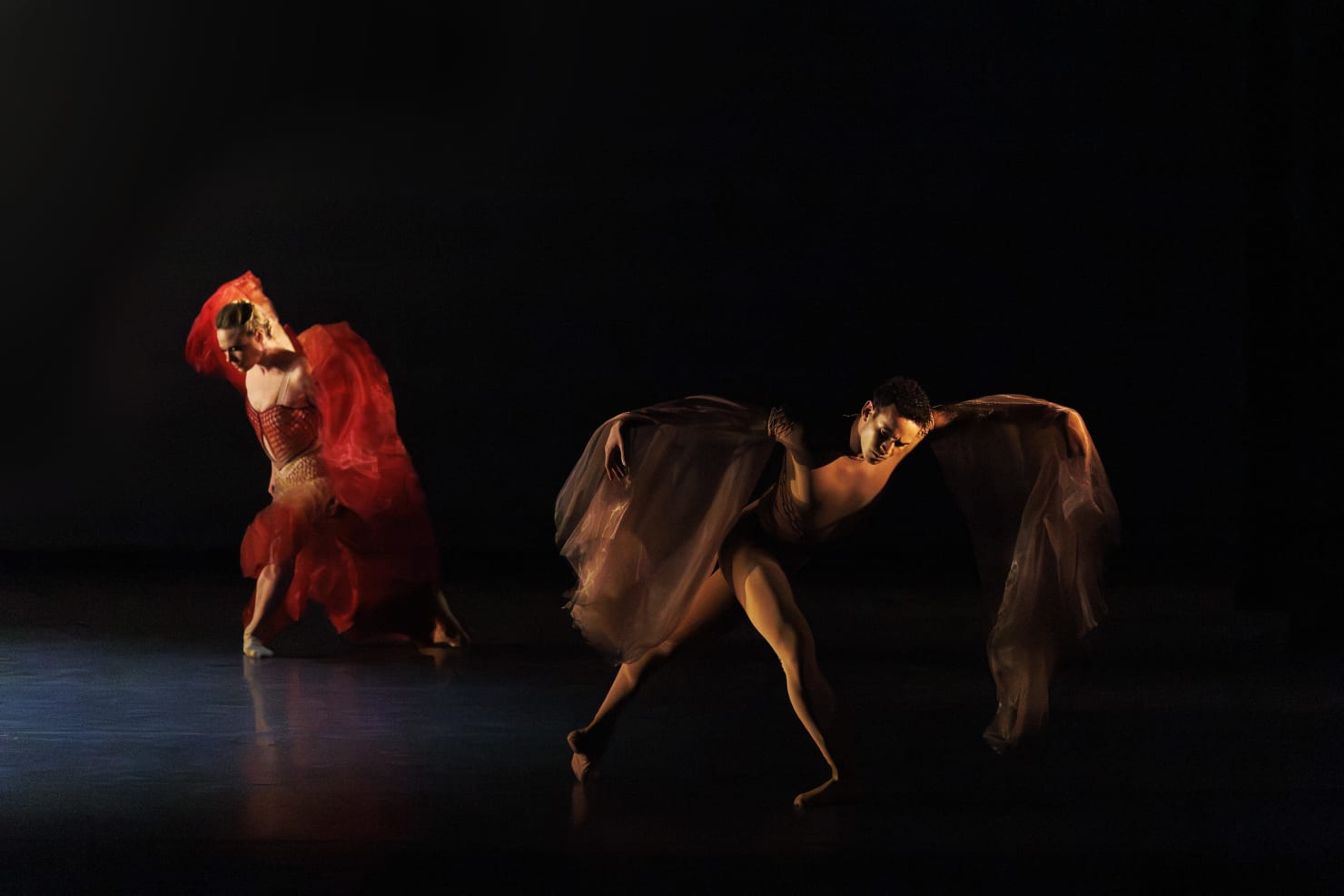
Likely more polarizing — but a bit more interesting — is Jamar Roberts’ Foreseeable Future (RECOMMENDED), which enjoyed its world premiere at this year’s Fall Fashion Gala. One of the most intriguing things about Roberts, ever the deeply sensitive artist, is how utterly distinct his works are from one another. While his latest for City Ballet is far from perfect, the ballet seems grounded in an authentic fascination with urgent philosophical musings of the here and now. More specifically, it artfully interrogates the intersection — or disconnection? — between the timeless beauty of the natural world and the evolution and forward drive of technological advancement. In Roberts’ fragile dance, these two spheres are juxtaposed but only tentatively intermingle. Choreographically, one group of dancers move with the glacial calm of nature, while the other group move angularly and aimlessly as if possessed by the relentlessness of an impassive, automated technological world. Similarly, the ballet’s striking design elements speak to this friction — the moody and restless electronic soundscape by trailblazing transgender musician and record producer Arca is at once organic and rigid, while the costume design by Dutch fashion designer Iris van Herpen adorn the dancers with voluptuous and voluminous flowing light fabric (representative of the natural world), as well as minimalist, highly structured outfits (indicating technology). The opening cast gamely succumbed to Roberts’ specific vision — of particular note were the otherworldly contributions of Sara Mearns, Isabella LaFreniere, Taylor Stanley, and Ryan Tomash as the group portraying the nature — even if the overall end result feels more like inquisitive performance art than it does a totally satisfying choreographic thought. Other works on the boldly contemporary bill, alas sans full orchestra (which I missed!), included Ratmansky’s Voices, Reisen’s Composer’s Holiday, and Forsythe’s Herman Schmerman Pas de Deux — all fiercely distinctive works.
NEW YORK CITY BALLET
Dance
David H. Koch Theatre
Program running times vary
Fall season concluded
 Copyright © 2026
Leave a Reply