
VIEWPOINTS – A recent trip to Chicago proves that its reputation as a world class theater town remains intact
- By drediman
- June 24, 2016
- No Comments
The Windy City is widely known as one of the theater capitals of the world. From venerated institutions like the Steppenwolf Theatre Company and the Goodman Theatre to scrappy, wildly adventurous so-called “storefront” theaters (of which the now scandalously defunct Profiles Theatre was one), the Chicago theater scene abounds in bold homegrown projects for the stage. On a recent trip to Chicago, I was able to visit some of the current productions on the boards of some of the city’s most notable theaters. Once again, I was reminded of the depth of talent on display on these stages, not just in terms of gutsy, top-notch actors, but visionary directors and designers, as well.
Chicago Shakespeare Theatre
Since moving to its current location on Navy Pier during its 2000/2001 season, the Chicago Shakespeare Theatre has not only become the cornerstone of the famous tourist destination, it’s also built itself into one of the major Shakespeare theater companies in the country.
TUG OF WAR: FOREIGN FIRE
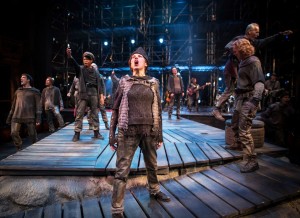 As one of the centerpieces of Shakespeare 400, the Chicago theater community’s unprecedented celebration of the 400th anniversary of the Bard’s death, artistic director Barbara Gaines has staged the audacious Tug of War: Foreign Fire, a six-hour theatrical marathon comprised of Shakespeare’s Edward III, Henry V, and Henry VI Part 1. Foreign Fire, which focuses on England’s foreign affairs and wars abroad (particularly with France), is the first half of a larger story which continues with the domestically driven Civil Strife (set to open in the fall), which is made up of Henry VI Parts 2 & 3 and Richard III. Foreign Fire, which is driven by a punk rock sensibility – there’s an onstage band that provides spiky musical commentary throughout – features one of the most spectacular assembly of Chicago actors I think I’ve seen. It was a tremendous pleasure to see such luminaries as Karen Aldridge, David Darlow, Kevin Gudahl, Heidi Kettenring, Michael Aaron Lindner, Barbara Robertson, and Larry Yando stalk the stage first and foremost as part of an ensemble, a true heritage of the Chicago school.
Steppenwolf Theatre Company
Anyone who knows anything about theater can tell you that the Steppenwolf is the poster child of Chicago theater. Over the years, it’s grown from its storied humble origins in the basement of a Highland Park church to one of the pillars of Chicago’s affluent Lincoln Park neighborhood. Despite this tremendous growth, the company has thankfully retained its visceral, ensemble-driven approach to theater-making.
MARY PAGE MARLOWE
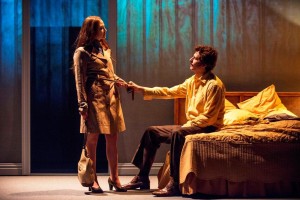 Tracy Letts just may be the Eugene O’Neill of our time. Best known for his searing Pulitzer Prize and Tony-winning family drama August: Osage County, Mr. Letts honed his playwriting (and acting) skills on Chicago’s stages, particularly at the Steppenwolf. In comparison to his opus, his latest, Mary Page Marlowe, pales in comparison – both in scope and in substance, at least initially. However, look more closely and you’ll find a deeply insightful play about time and identity. Mr. Lett’s slight, episodic play, which depicts a woman at various stages of her life (each “version” of Mary Page is played by a different actress), makes the somewhat unsettling suggestion that we as human beings are inherently amorphous; who we are changes from moment to moment. This world premiere at the Steppenwolf is directed with great delicacy and fluidity by artistic director Anna D. Shapiro. Very much like Barbara Gaines’ Tug of War at Chicago Shakespeare, the big guns of Chicago theater have come together for Mr. Letts’ latest, which includes Ian Barford, Carrie Coon, Laura T. Fisher, Kirsten Fitzgerald, Sandra Marquez, Alan Wilder, Gary Wilmes. The great Blair Brown rounds out the impressive cast.
VOICE LESSONS
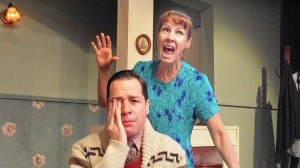 A production of Justin Tanner’s 2009 Voice Lessons is among the first crop of shows to play the brand spanking new 1700 Theatre, the Steppenwolf’s intimate new black box space. Mr. Tanner’s campy hour-long play about a voice instructor (played by French Stewart), his outrageous and talent-free student (played by the fierce Laurie Metcalf), and the interloper who de-stabilizes the status quo (played by Maile Flanagan). Each of the show’s three actors give fearless performances, particularly Ms. Metcalf, who here is intense and larger-than-life – but then again, when is she not? Voice Lessons is the kind of play and scrappy production (directed by Bart Delorenzo) that harkens back to the early days of the Steppenwolf.
Goodman Theatre
Along with the Steppenwolf, the Goodman Theatre, which is located in Chicago’s downtown area (known as the “Loop”), is widely considered the Windy City’s other flagship theater company. Under the guidance of artistic director Robert Falls, the company has produced a wide range of works, from classics to cutting edge new work.
THE SIGN IN SIDNEY BRUSTEIN’S WINDOW
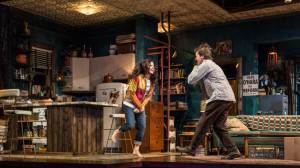 In the Albert Theatre (i.e., the mainstage), I caught a sensational and deeply moving revival of The Sign in Sidney Brustein’s Window, the very rarely-performed final play by Lorraine Hansberry (Ms. Hansberry died just months after her play opened on Broadway, where it was tepidly received). Ms. Hansberry’s play, about uncompromising idealism in the face of corruption and moral ambiguity, is here directed by truthfulness and compassion by the hard-working Anne Kauffman. Special mention must go to set designer Kevin Depinet, whose impressively detailed Greenwich Village apartment set brings a specificity and gritty reality to the play. The cast is superb and is led by Chris Stack, who gives a towering performance as the idealist Sidney. As Sidney’s frustrated girlfriend, Diane Davis, who was so bruising in the title role of Nice Girl last season at New York’s Labyrinth Theater Company, is touching and real. Nuanced supporting turns are also given by the reliable veteran actor Guy van Swearingen and Grant James Varjas.
SOUP, STEWS, AND CASSEROLES: 1976
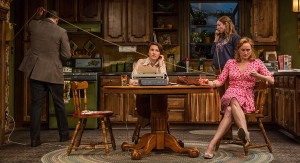 In the Owen Theatre (i.e., the Goodman’s smaller flexible space), I was also able to see Soup, Stews, and Casseroles: 1976 by Rebecca Gilman. Ms. Gilman is a long-standing stalwart playwright of Chicago theater who has had a steady and prolific relationship with the Goodman, particularly with artistic director Robert Falls (who also directed this piece). Her latest play chronicles the waning days of a Wisconsin cheese factory – particularly its affect on one Midwestern family – after having been purchased by a Chicago-based conglomerate. Even if Ms. Gilman’s latest play is second tier when compared to her previous, more sophisticatedly written and structured plays, it’s still a pleasure to hear her quietly incendiary voice up on the Goodman stage in a new work. As the matriarch of the family, Cora Vander Broek struck me as a bit bland. However, I’ve never seen the excellent and handsome Cliff Chamberlain, who plays the conflicted breadwinner, better-suited to a role as he is here.
The House Theatre of Chicago
Since its establishment in 2001, The House Theatre of Chicago, now based in the bohemian Chopin Theatre in the hip Wicker Park neighborhood, has become renown for producing adventurous new works that playfully push the boundaries of theatrical storytelling.
THE LAST DEFENDER
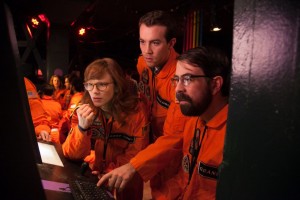 In the Cold War-era The Last Defender, written and directed by artistic director Nathan Allen, the House Theatre of Chicago once again pushes the boundaries of what live entertainment – I’m hesitant to label the piece “theater” – can be. Essentially, The Last Defender is a glorified problem solving exercise (or an I.Q. test, if you will) that involves a band of top secret so-called defenders (i.e., the “audience”) working together to thwart impending Soviet nuclear threats from their secret underground headquarters. To do so, the defenders must execute a number of teamwork-oriented mind twisting tasks before time runs out. The experience can get pretty intense, but it can all get rather fun and involving once you allow yourself to give into the role playing. As with most immersive theatrical experiences, you get out of it as much as you put in.
The Second City
Like the blues, improv has long been central to Chicago’s cultural fabric. And by all accounts, The Second City, which is based out of Chicago’s Old Town neighborhood, is inarguably the gold standard of the genre – not just in the city, but the world over.
FOOL ME TWICE, DÉJÀ VU
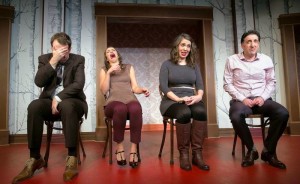 The Second City’s 104th mainstage revue, Fool Me Twice, Déjà Vu, once again proves why the institution remains unmatched in the world of improv. The folks at the Second City have an uncanny ability to walk the fine line between in-the-moment hilarity and slicing, scripted precision. As with most of their revues, their 104th mainstage review is consistently topical, smart, at times boldly lowbrow, and always skillfully performed. The main conceit of Fool Me Twice, Déjà Vu is to revisit the sketches performed int he first act in the show’s second half (hence the title), but from different comic angles. The results are very funny, and often insightful and fascinating. Kudos to the crew of Chelsea Devantez, Paul Jurewicz, Rashawn Nadine Scott, Sarah Shook, Daniel Strauss, Jamison Webb, who wrote and perform in the revue.
Northlight Theatre
Currently located in Skokie, Northlight Theatre is one of Chicago’s major suburban theaters, producing a healthy mix of established and new works. Northlight is slated to move back to Evanston (where the theater company was founded) in the near future.
THE GOSPEL ACCORDING TO THOMAS JEFFERSON, CHARLES DICKENS AND COUNT LEO TOLSTOY: DISCORD
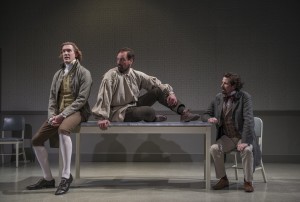 With its incredibly – and unnecessarily – long title, The Gospel According to Thomas Jefferson, Charles Dickens and Count Leo Tolstoy: Discord, it’s clear that playwright Scott Carter (of Real Time with Bill Maher fame) has some big things to say. In his engaging and philosophical new play, Mr. Carter has historical figures Thomas Jefferson, Charles Dickens, and Leo Tolstoy meet in some sort of purgatorial realm. There, they discuss and argue about the nature of religion and the power of creation through the pen (each were avid writers and, coincidently, each also wrote their own version of the Gospels). Northlight’s production is smartly and snappily directed by Kimberly Senior and features an exceptional trio of actors: Nathan Hosner as Thomas Jefferson, Mark Montgomery as Count Leo Tolstoy, Jeff Parker as Charles Dickens.
Court Theatre
Nestled amidst the ivied gothic walls of the University of Chicago in Hyde Park is the Court Theatre, a gem among the plethora of Chicago theaters. Although the Court’s mandate is to stage the classics (which includes modern classics, as well), it’s managed to become one of the most theatrically daring and sophisticated troupes in town.
ONE MAN, TWO GUVNORS
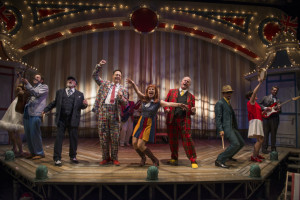 Richard Bean’s One Man, Two Guvnors is known to most as the vehicle that catapulted James Corden to superstardom. When I saw this British update of the commedia dell’arte classic The Servant of Two Masters on Broadway, I felt that it was mostly inspired lunacy (largely due to Mr. Corden’s masterful performance), but that it had its fair share of merely pedestrian moments. However, as directed by Court’s artistic director Charles Newell, this version of Mr. Bean’s play felt much more cohesive and was pretty brilliant throughout its two and a half hour running time. I credit this to director Mr. Newell, who has staged the play in a manner closer to commedia dell’arte aesthetics than Nicholas Hytner’s original production (which veered towards English music hall than anything else). Once again, a number of A-listers from the Chicago deep acting pool have been assembled here, including Chaon Cross, Allen Gilmore (a commedia dell’arte expert), Francis Guinan, Timothy Edward Kane (in the James Corden role, thrillingly making the role his own), Elizabeth Ledo, Ross Lehman, and the always fabulous Hollis Resnik.
 Copyright © 2026
Leave a Reply