
VIEWPOINTS – PROTOTYPE 2026 Roundup: Beth Morrison Projects continues to shape the aesthetic of contemporary opera
- By drediman
- January 26, 2026
- No Comments
Aside from Under the Radar, January’s other marquee performing arts festival is Prototype, an undisputed nexus for the presentation of new and often times gutsy opera. For the festival’s 2026 edition, Beth Morrison Projects — which this year is celebrating its astonishing 20th anniversary and is headed by its namesake, Beth Morrison, one of the visionary and relentless forces behind the whole operation — increased its hold of Prototype, more than ever continuing to shape the aesthetic of contemporary opera (e.g., favoring visceral soundscapes, multidisciplinary presentations, subversive subject matters, amplification, and an overall out-of-the-box approach to music theater). Read on for my thoughts on yet another successful Prototype season, particularly in its telling of the stories of uncompromising women, bold subjects that call to mind Beth Morrison herself.
BMP: SONGBOOK LIVE
National Sawdust
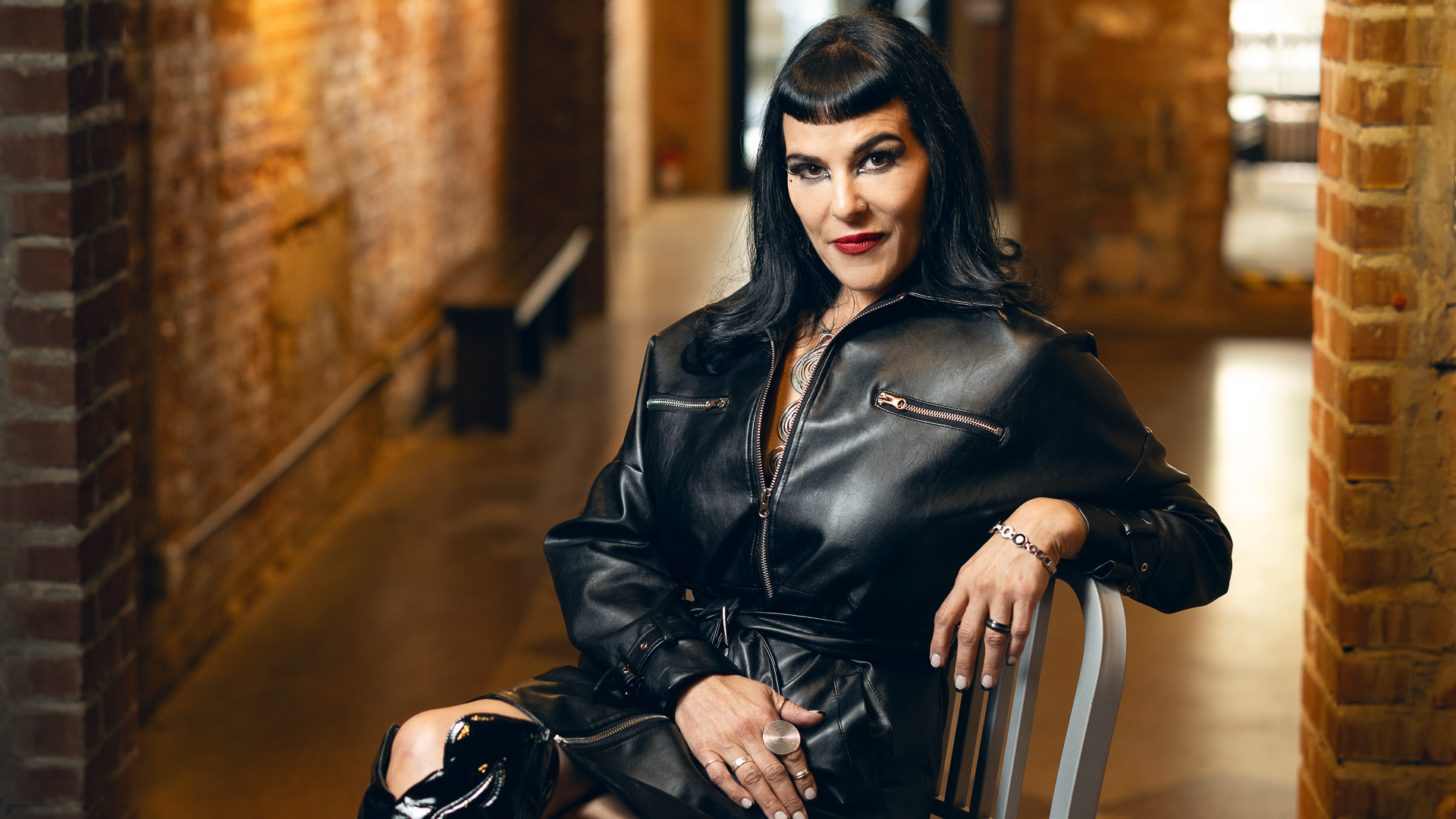
I can’t think of a better way to have kicked off Prototype 2026 than with BMP: Songbook Live (HIGHLY RECOMMENDED), a thoroughly satisfying retrospective concert of some of the highest highs of the last two decades of Beth Morrison Projects. For the live concert at National Sawdust in Williamsburg — performed on two consecutive nights — BMP re-assembled many originating artists from past Prototype productions. Accompanying these concerts were the releases of the BMP: Songbook Anthology, a comprehensive two-volume collection of more than 60 arias from music theater pieces commissioned by BMP, as well as a hardbound commemorative book chock full with photos, interviews, and anecdotes from many of the creative artists behind these projects over the years. In essence, the concert was a live amalgamation of these legacy-affirming releases, complete with powerful live performances and projected video testimonies by a myriad of BMP’s distinguished collaborators. As sensitively conducted by music director Kazem Abdullah, some of the more stunning highlights from the eclectic evening included “The Legend of the Ten Suns” from Huang Ruo’s Book of Mountain and Seas, “Lumee’s Dream” from Ellen Reid’s Pulitzer Prize-winning Prism, and “Mirror, Mirror” from David T. Little’s Dog Days. Together, these were shining examples of the exciting musical innovation and theatricality that are the hallmarks of both BMP and Prototype.
HILDEGARD
Gerald W. Lynch Theater
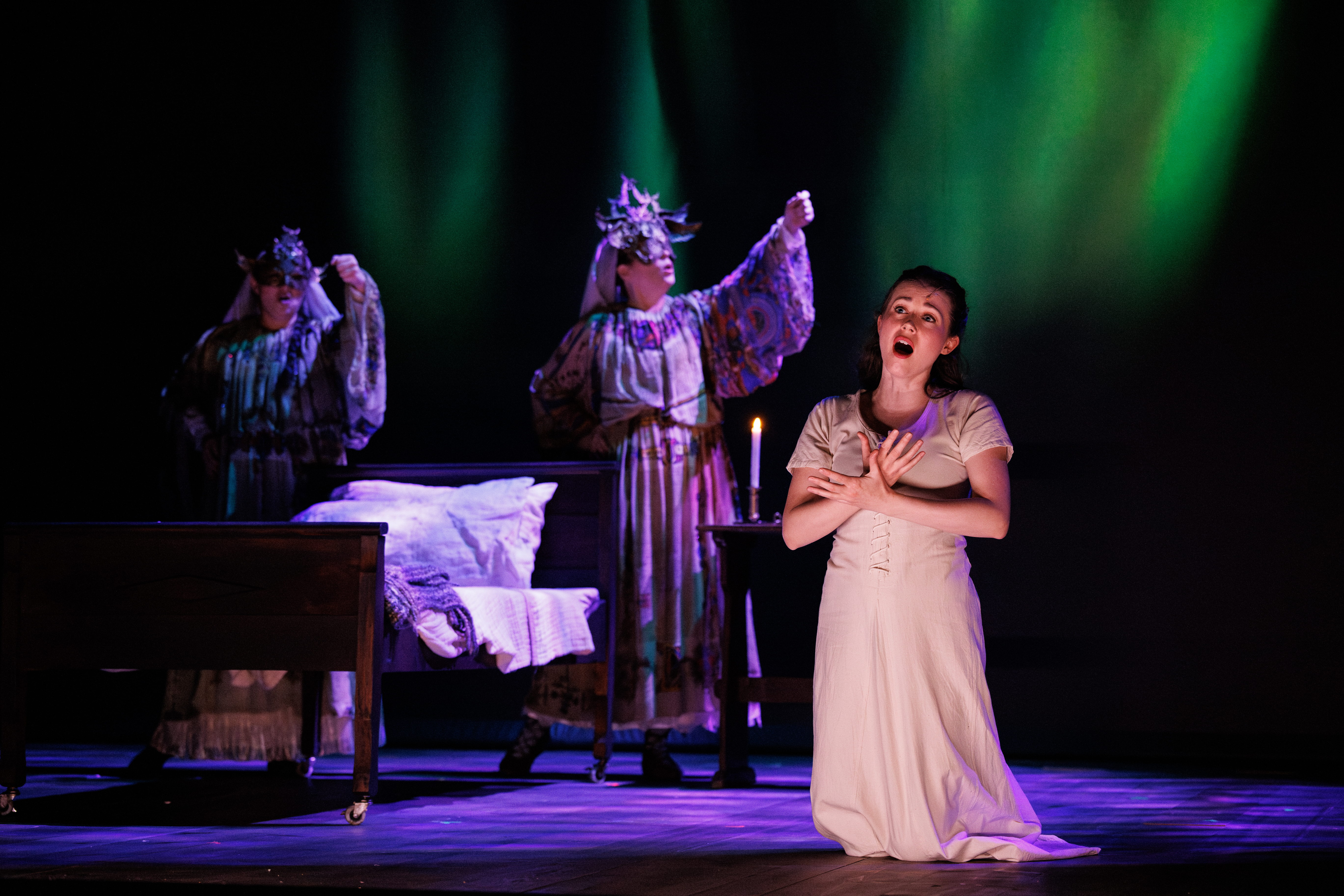
The first of the festival’s fully staged operas was the New York premiere of Hildegard (RECOMMENDED), Sarah Kirkland Snider‘s sensuous operatic take on the life of St. Hildegard von Bingen. Presented at the Broadway-sized Gerald W. Lynch Theater at the John Jay College of Criminal Justice in Hell’s Kitchen, Snider’s opera — which features a sparkling score, complete with floating and elegant vocal writing and evocative orchestrations — seamlessly weaves between Hildegard’s practical yet bold political maneuvering as a woman within the male-dominated machinations of the Catholic Church and her rapturous supernatural visions (allegedly from God). Contemplatively directed by Elkhanah Pulitzer, the production fluidly unfolded in a series of scenes that steadfastly told Hildegard’s trailblazing story, paying particular attention to her many-layered relationship with the young convalescent and artist Richardis von Stade, with whom she shares an uncommon and (as of yet) undefined intimacy with. Visually, the staging was often visually captivating — if at moments clunky — as aided by video projections and a mobile sculptural cube that gave opportunities for Pulitzer to create a number of striking stage pictures. As Hildegard, soprano Nola Richardson gave a beautifully measured performance — both vocally and dramatically — ideally manifesting the character’s undaunted determination. But perhaps giving the more beguiling performance as Richardis was Mikaela Bennett, whose tortured performance and otherworldly singing stayed with me long after the curtain had come down.

PRECIPICE
Co-presented by La MaMa Experimental Theatre Club
The festival’s sole world premiere opera at La MaMa was Roma Fand and Karen Fisher’s Precipice (HIGHLY RECOMMENDED), a visceral operatic depiction of a stifled voice juxtaposed against the expansive geographic landscape of the American wilderness. More specifically, the work tells the tale of Ana, a young woman who struggles to operate within the rules that have been established for her, whether by her staunch family or more general societal expectations. At once artful and hard-hitting, the production was a true collaboration between concept, design, and musical composition (the concept and production design are credited to Susan Zeeman Rogers, while the score to Fand and Fisher). In my opinion, the opera is a stylistic triumph, starting with Fand’s music, which is an intoxicating blend of American folk music (a mandolin is prominently featured in the orchestrations), forward thinking music theater, and sonic evocations of the natural world. Design-wise, Rogers and director Mallory Catlett elicited some striking and poetic visuals of the mountainous terrain of the American west — to which our misunderstood heroine repeatedly escapes when she’s cornered by the world — particularly with the ingenious incorporation of both miniature dioramas and large-scale video work. And giving perhaps the performance of the festival as Ana was Alice Tolan-Mee, whose guttural vocal performance and raw, brave dramatic portrayal of a woman with nowhere else to turn to utterly disarmed me. As with Mikaela Bennett in Hildegard, it’s a performance that I found myself still thinking about days later.
WHAT TO WEAR
Co-presented by Brooklyn Academy of Music
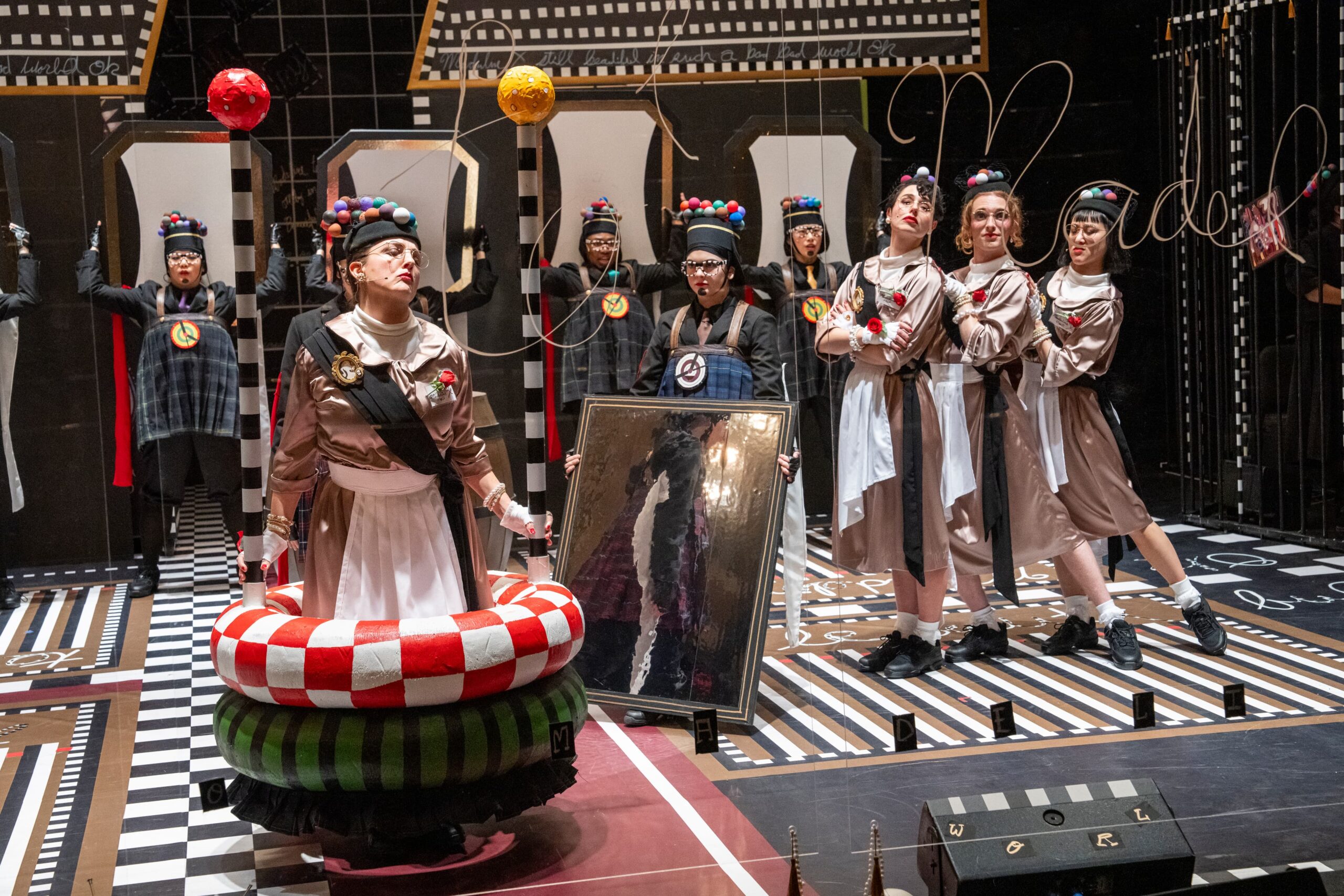
Perhaps Prototype 2026’s most anticipated event was the return of experimental composer Michael Gordon‘s What to wear (HIGHLY RECOMMENDED), a 2006 work in which post-rock opera and absurdist theater (and ducks) exuberantly intertwine and combust to abstractly critique our obsession with beauty and the overall pressures of modern society. Brooklyn Academy of Music’s co-presentation of the late iconoclastic director Richard Foreman’s original production — carefully staged by choreographer Annie-B Parson and avant-garde theater-maker Paul Lazar (and featuring special guest St. Vincent) — amounted to a coup and nothing less than a hypnotic sensory feast. Suffice to say, the sold out 20th anniversary production at the BAM Harvey Theater didn’t disappoint. Featuring music-making by Bang on a Can All-Stars (under the excellent music direction of Alan Pierson), this historic re-mounting is at once an emphatic commemoration of the theatrical legacy of the late, much missed Foreman — whose productions operate under the kind of loosely associative logic that’s often baffling to audiences — and cements Gordon’s singular ability to synthesize a distinctive sound from disparate musical influences. The end result was a meticulously presented and performed hallucinatory tone poem that mesmerized me from start to finish. The project also fits squarely within Beth Morrison’s vision to start bringing back successful productions from the past in the hopes of establishing a more definitive repertoire of contemporary works of music theater.

TIERGARTEN
Co-presented with Death of Classical at St. Paul’s Carroll Street
Continuing Prototype’s fascination with more intimate and immersive modes of performance was Tiergarten (RECOMMENDED), a time- and genre-spanning cabaret that seemingly took place at the end of the world. The written and directed by Death of Classical’s Andrew Ousley — the tireless classical music impresario with a flair for unconventional experiences — the piece was named after the Tiergarten (the term translates to “The Garden of Beasts”), which is the park in Berlin around which the villainous figureheads of the Third Reich came to power. In essence, Ousely’s ambitious variety show captured the anxieties of our time via a time traveling examination of the history of human civilization, from our present day predicaments to the mythic beginnings of our existence. To say that the experience was eclectic would be an understatement. For this iteration of the speakeasy cabaret — which transpired down a candle-lit alleyway of St. Paul’s Carroll Street in the church’s assembly hall — Ousley casted a wide net, presenting a musical cornucopia that included wide-flung songs from the likes of Kurt Weill, Max Richter, Dean Martin, Verdi, The Rocky Horror Picture Show, Handel, and William Byrd. The diversity didn’t end there. Tapping into the talents of the young and committed cast, also on tap were performances that encompassed modern dance burlesque, not to mention ample food and libation for the entire audience at this imagined 1920s Weimar Speakeasy to enjoy. Confidently holding it all together with a wink and a smirk was the fabulous Kim David Smith, the evening’s Master of Ceremonies.
 Copyright © 2026
Leave a Reply